
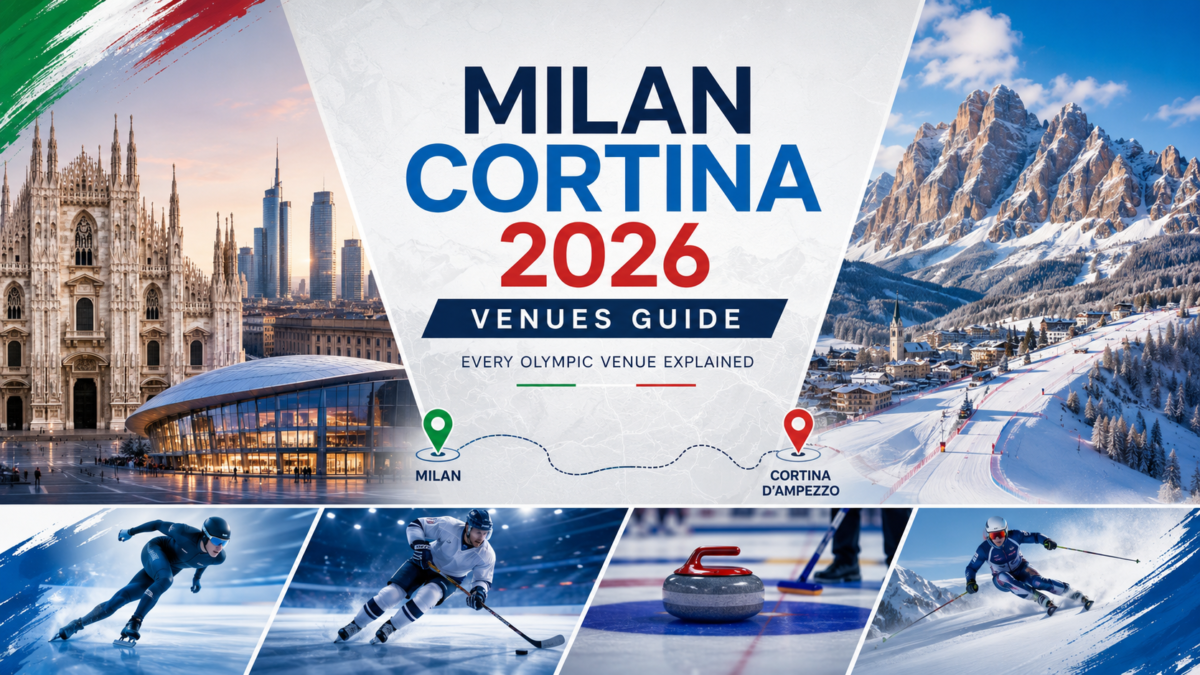
The 2026 Winter Olympics — officially the XXV Olympic Winter Games — arrive in Italy’s stunning Dolomites and Milan’s world-class arenas from February 6 to February 22, 2026. With competition taking place across three distinct clusters, Milan-Cortina is the first dual-city Winter Olympics in history. Here’s your complete guide to every venue.
Overview: Three Clusters
Unlike any previous Winter Games, Milan-Cortina spreads its events across three geographic clusters:
- Milan — Urban indoor venues in Italy’s fashion capital
- Cortina d’Ampezzo — Classic alpine venue in the Dolomites
- Valtellina/Livigno and Bormio — Alpine skiing, biathlon and cross-country venues
Milan Venues
Palazzo del Ghiaccio — Ice Hockey, Short Track, Figure Skating
Built in 1923, this legendary ice palace in the heart of Milan has been fully renovated for the 2026 Games. It will host figure skating and short track speed skating — two of the Winter Games’ most-watched disciplines. Capacity: 8,500.
Mediolanum Forum (Assago Arena) — Ice Hockey
Home to the HC Milano Devils and the venue for the NBA preseason games, this modern arena will host group stage ice hockey matches. Capacity: 12,700.
Santa Giulia Ice Rink (NEW) — Curling, Ice Hockey
A brand-new arena purpose-built for the Olympics in Milan’s regenerated Santa Giulia district. Post-Games it will become a multipurpose sports venue for the local community. Capacity: 11,000.
Cortina d’Ampezzo
Olympia delle Tofane — Alpine Skiing (Women’s)
One of the most iconic ski runs in the world, the Olympia delle Tofane has hosted World Cup alpine events for decades. The women’s downhill here will be one of the most dramatic events of the Games, with the jagged Dolomite peaks forming a breathtaking backdrop.
Sliding Centre — Bobsled, Luge, Skeleton
After much debate, a new sliding centre was approved for Cortina. Italy’s only bobsled track will host all three sliding sports, giving Italian athletes a home-track advantage for the first time in generations.
Cortina Curling Stadium — Curling
The purpose-built curling venue in central Cortina will become the town’s community ice centre after the Games.
Valtellina Cluster
Bormio — Alpine Skiing (Men’s)
The legendary Stelvio run at Bormio is one of alpine skiing’s most demanding courses. The men’s downhill and super-G will be held here, attracting the sport’s biggest stars.
Livigno — Freestyle Skiing, Snowboard
High-altitude Livigno (1,816m) is perfect for the more acrobatic disciplines. A new snow park has been constructed for halfpipe, slopestyle and big air events.
Anterselva/Antholz — Biathlon
Home to one of the Biathlon World Cup circuit’s most beloved venues, Anterselva combines a demanding shooting range with scenic cross-country trails in South Tyrol.
Tesero and Lago di Tesero — Cross-Country Skiing, Nordic Combined, Ski Jumping
The Val di Fiemme venues hosted two Nordic World Championships and return for their third major event. The ski jumping hill has been modernised with improved safety features and spectator capacity.
Opening and Closing Ceremonies
The Opening Ceremony takes place at the iconic San Siro (Stadio Giuseppe Meazza) — one of the most famous football stadiums in the world. The Closing Ceremony will be held in Verona’s spectacular Arena di Verona, a 2,000-year-old Roman amphitheatre.
Venue Legacy
A key commitment of the Milan-Cortina bid was sustainability and legacy. Every venue is being designed or renovated with post-Games use firmly in mind — ensuring the infrastructure benefits local communities in the Dolomites and Lombardy for decades to come.
Medal & More will provide live coverage of every event at Milan-Cortina 2026 from February 6.




Leave a Reply