
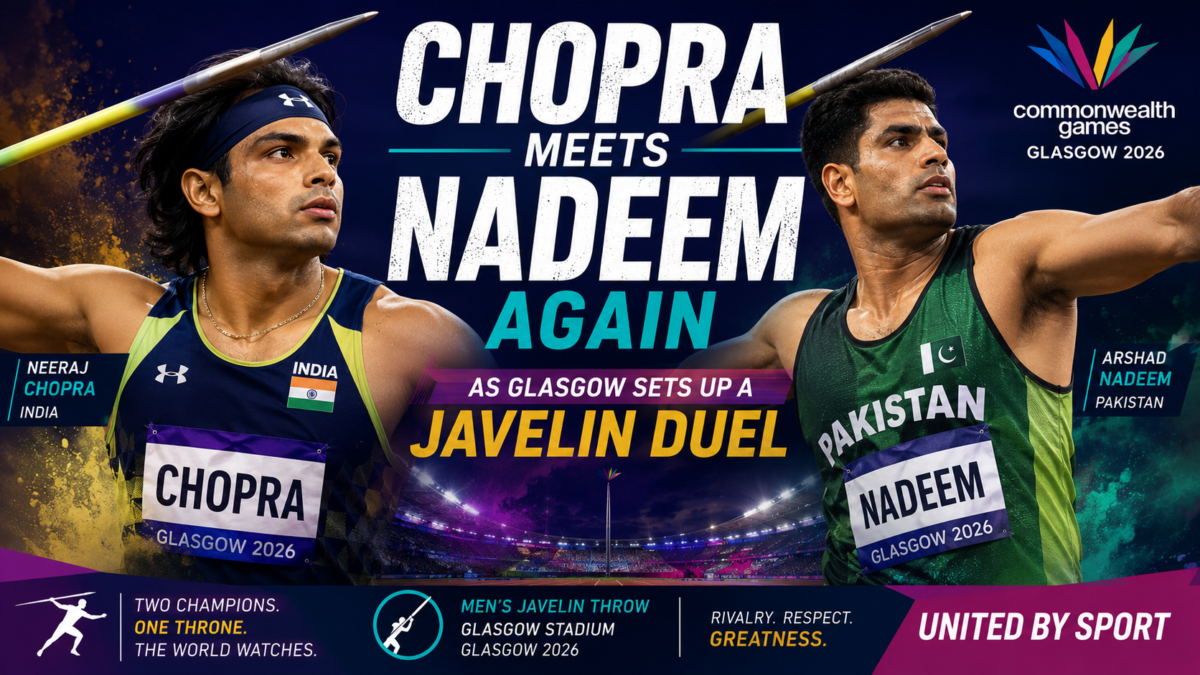
The most anticipated individual contest of the Glasgow 2026 Commonwealth Games will not take place until the second Saturday. Neeraj Chopra and Arshad Nadeem, the two men who have defined javelin throwing for most of the last decade, are scheduled to meet in the final on 1 August, with qualification two days earlier on 30 July.
Two careers, one rivalry
The rivalry has an unusual shape. Chopra won Olympic gold in Tokyo and has spent the years since as the most consistent thrower in the world, a model of technical repeatability who rarely has a bad competition. Nadeem is the opposite, a thrower capable of producing something extraordinary and something ordinary in consecutive rounds, and it was one of those extraordinary attempts that took Olympic gold away from Chopra in Paris.
At Commonwealth level the picture is different again. Nadeem is the defending champion, having won in Birmingham in 2022 in Chopra’s absence. Chopra last competed at these Games in 2018, when he won gold on the Gold Coast, and he skipped the last edition entirely. Glasgow is therefore the first Commonwealth Games in eight years at which both men will actually be on the runway at the same time.
The third man
Framing this as a two-way contest may be a mistake. Sri Lanka’s Rumesh Pathirage has thrown beyond 90 metres this season, a barrier that only a handful of athletes in history have cleared, and he arrives in Glasgow as one of the form throwers on the circuit rather than a hopeful outsider. A Commonwealth javelin final containing three genuine 90-metre candidates would be the strongest field the event has ever assembled at these Games.
That depth is worth dwelling on. Javelin is one of the few athletics events in which the Commonwealth field is close to the global field. India, Pakistan, Sri Lanka, Grenada, Trinidad and Tobago, Kenya, Australia and the home nations all produce serious throwers, and the absence of the European powers matters less here than it would in almost any other discipline.
Chopra’s season
Chopra has spent recent weeks training in Switzerland, intensifying his preparation for a compressed second half of the year that includes both Glasgow and the Asian Games. Anju Bobby George, among others, has publicly backed him to peak across both, though the scheduling is unforgiving and Chopra has historically been careful about how many competitions he loads into a season.
He arrives as the headline name in India's 126-athlete delegation, alongside Mirabai Chanu and Lovlina Borgohain, in a Games where India's medal ceiling has been lowered considerably by the removal of several traditional strengths from the programme. Athletics provides 32 of India’s competitors and now carries a disproportionate share of the expectation.
Why the format helps
The javelin has a quality that suits a Games trying to hold a broad audience. It is instantly legible, it resolves in six throws, and the distances mean something to people who have never followed athletics. Scotstoun will host the combined athletics and Para athletics programme across six days from 27 July, and a final featuring Chopra and Nadeem will be the ticket everyone wants.
There is also a subcontinental dimension that neither man particularly enjoys discussing and neither can escape. India and Pakistan meeting in an Olympic-level individual final is a rare thing, and the two throwers have generally handled the surrounding noise with more grace than the noise deserved. Nadeem has spoken warmly about Chopra, Chopra has defended Nadeem publicly when required, and both appear to regard the other primarily as the standard to be measured against.
On 1 August at Scotstoun, that measurement gets taken again.


Leave a Reply