
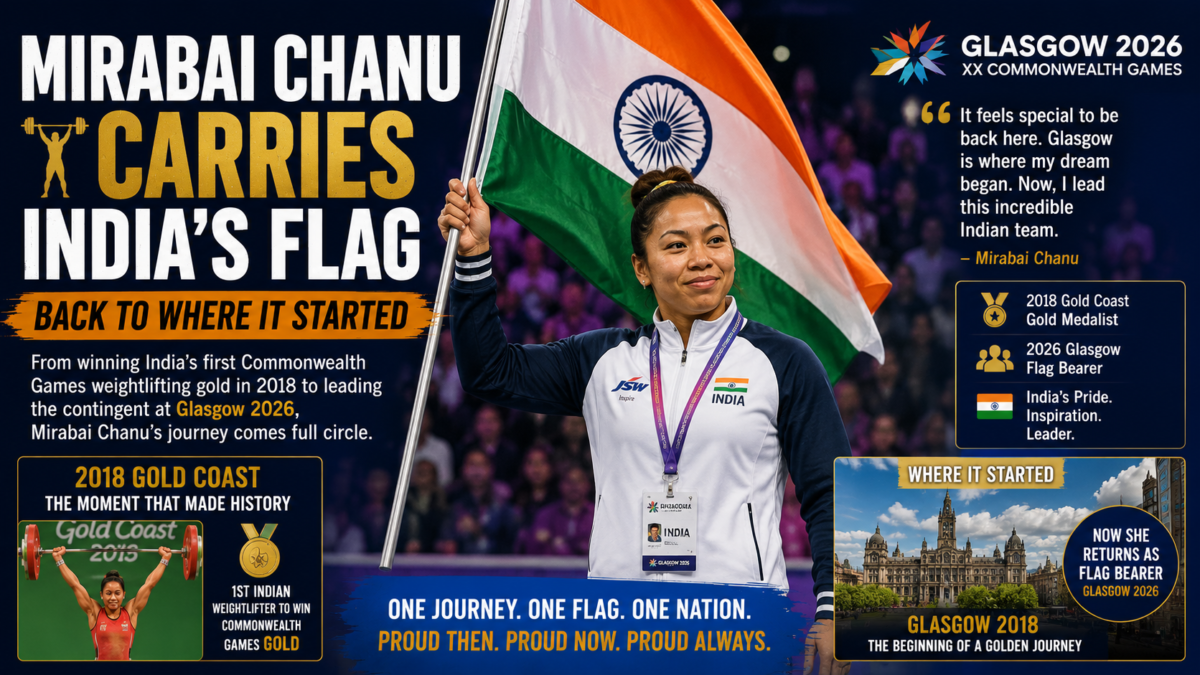
Twelve years ago a 19-year-old weightlifter from Manipur won a silver medal in Glasgow that almost nobody outside her sport noticed. On Thursday, Mirabai Chanu will lead India into the Hydro as flag bearer at the opening ceremony of the Commonwealth Games, in the same city where her international career began.
Glasgow to Glasgow
Chanu’s Commonwealth record now reads silver in Glasgow in 2014, gold on the Gold Coast in 2018 and gold in Birmingham in 2022, three medals from three appearances. In between came the Tokyo Olympic silver that made her a household name in India and the injuries and rehabilitation cycles that have shaped everything since.
Being handed the flag is a recognition of that continuity as much as the medals. India's 126-athlete contingent for Glasgow includes Olympic medallists in athletics and boxing, but few athletes in the delegation have been competing at this level for as long as Chanu has, and none have a Commonwealth story that loops back to the same host city.
The 48kg question
She will compete in the women’s 48kg category when weightlifting runs from 26 to 30 July at the SEC Armadillo, the same venue that hosts Para powerlifting’s day-one medal programme. It is the division in which she won her Glasgow silver and her Gold Coast gold, and a return to it after competing at 49kg in Birmingham reflects both the reshuffled international weight classes and a body that has been managed carefully for several years.
Chanu has been notably clear about her intentions. She is targeting Commonwealth gold, but she has said publicly that she will not attempt a 200kg total in Glasgow, keeping the bigger lifts in reserve for the Asian Games later in the cycle. That is an unusual thing for an athlete to announce before a major championship, and it tells you something about where the Commonwealth Games now sits in the calendar for athletes with global ambitions. It is a title worth winning, but not at the cost of a season.
A thinner Indian programme
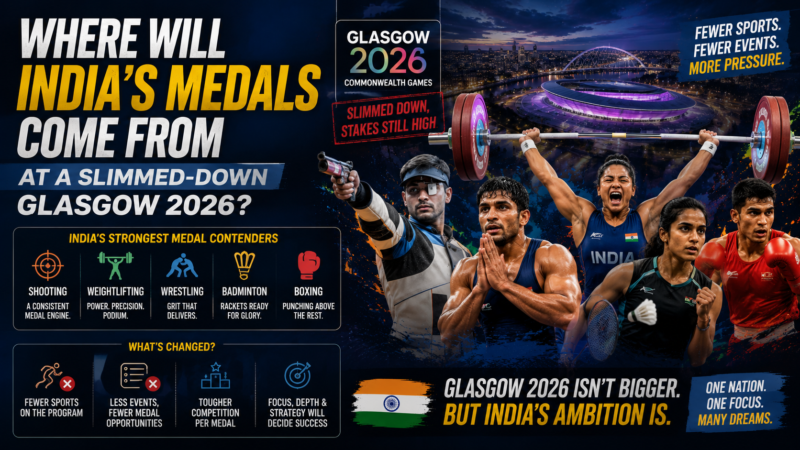
The context around her is less comfortable. Weightlifting is one of the disciplines that survived the reduction of the Glasgow programme to ten sports, while wrestling, badminton, cricket, hockey and shooting did not, removing several of India’s most reliable medal sources at a stroke. India’s realistic medal count in Glasgow will be a fraction of the 61 won in Birmingham, and the sports that remain carry the entire load.
That makes the weightlifting team unusually significant. Twelve lifters travelled, six women and five men across the categories, with Gyaneshwari Yadav, Bindyarani Devi, Harjinder Kaur and Lovepreet Singh among those expected to contend. Alongside the 32-strong athletics squad and 14 boxers, weightlifting represents one of the three pillars India is relying on.
What the flag actually means
Flag bearer selection is a soft-power decision as much as a sporting one, and federations tend to use it to signal something. Choosing Chanu signals durability. She has competed through a period in which Indian weightlifting has faced doping scandals, governance disputes and funding uncertainty, and she has remained the sport’s most credible public face throughout.
There is also the plain symmetry of it. Glasgow 2014 was the first major Games of her career, a competition she entered as an unknown teenager and left with a medal nobody expected. She returns as the most decorated weightlifter India has produced, at the front of the delegation, on the same stretch of the Clyde.
The Games run from 23 July to 2 August, with more than 200 gold medals available across ten sports and a record integrated Para programme. India’s campaign will be judged on totals, as it always is. Chanu’s Thursday night, at least, is already settled.


Leave a Reply