
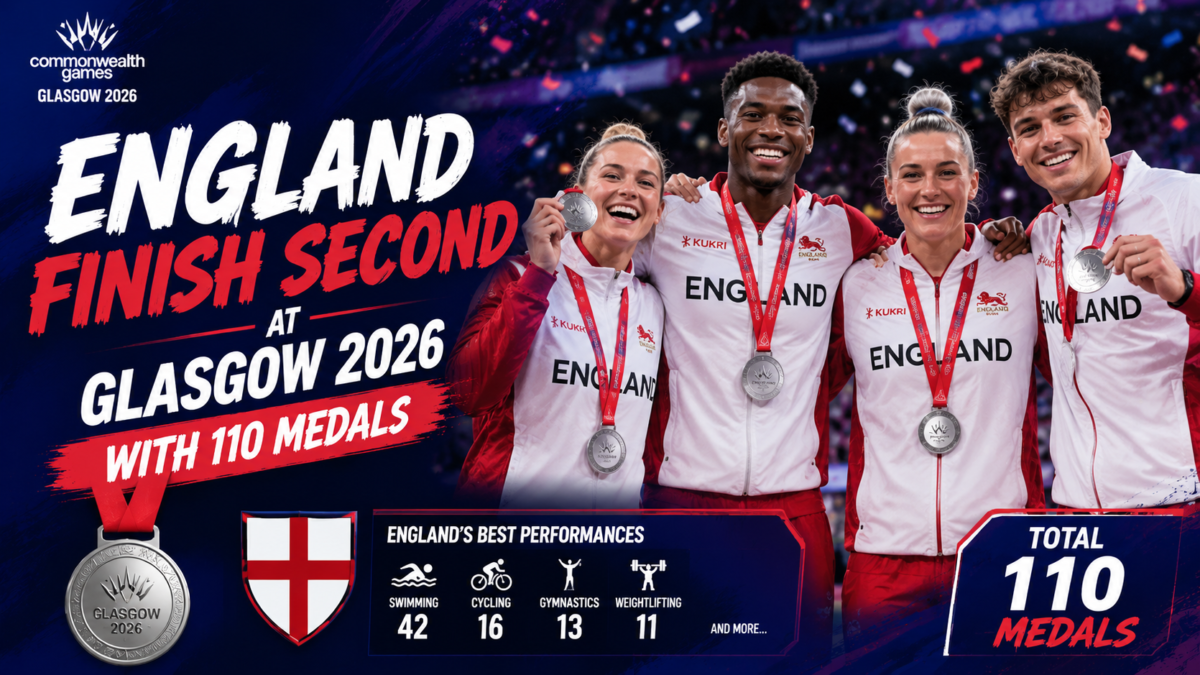
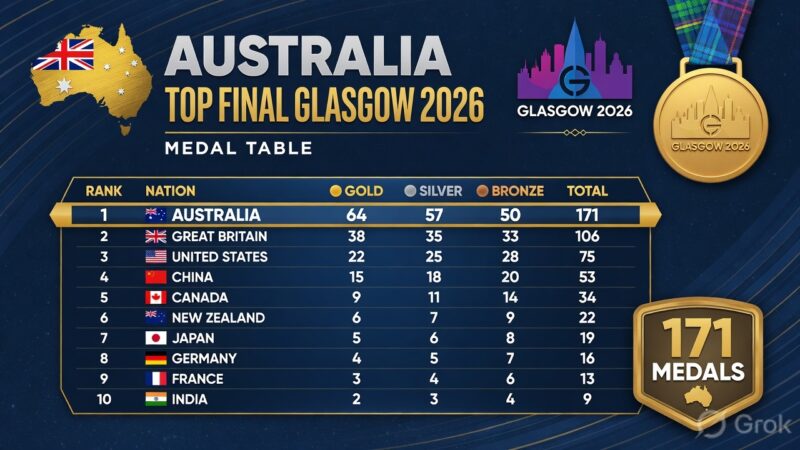
England have secured second place on the Glasgow 2026 Commonwealth Games medal table, closing the Games with 110 medals and one of their most productive campaigns at an event staged beyond their own borders. Having pressed hard throughout the fortnight in their charge up the standings, Team England ultimately settled into the runner-up position behind a dominant Australia.
Chasing the Leaders
England spent the Games in pursuit of the Australians at the summit, and while they could never quite bridge that gap, they comfortably held off the rest of the Commonwealth to claim second. A total of 110 medals reflected a broad and consistent campaign, with contributions arriving across the ten-sport programme rather than being concentrated in one or two disciplines.
That balance was the foundation of England’s success. Strong showings in the pool and on the track were supplemented by medals in gymnastics, cycling and the combat sports, giving the team the kind of depth that sustains a challenge across a full Games rather than a single strong week.
A Strong Away Performance
For an English team competing away from home, the runner-up finish carried particular significance. Home advantage often flatters host nations, and delivering a second-place finish and a triple-figure medal haul on Scottish soil demonstrated the underlying strength of England’s high-performance programmes.
The result stands comparison with England’s best returns at recent Games and will be viewed as a benchmark for the squad. Reaching 110 medals requires contributions from dozens of athletes across many sports, and assembling that kind of collective effort away from home is no small feat.
Standout Contributors
England’s medal charge was powered by a mix of established champions and emerging talents. Their swimmers were prominent throughout the pool programme, while the athletics squad added a steady stream of medals on the track and in the field. Across the disciplines, English athletes proved capable of turning finals into podium finishes.
That spread of contributors matters for the future. A campaign built on a wide base rather than a handful of stars suggests a system in good health, with talent coming through at various stages of development. Many of the athletes who shone in Glasgow will carry their form into the next Olympic cycle.
Part of a Home-Nations Story
England’s runner-up finish formed part of a strong overall showing from the home nations at Glasgow 2026. Alongside the host nation’s standout home Games, England’s performance ensured that the British and Irish contingent were prominent throughout the medal table, a reflection of the region’s depth in Commonwealth sport.
The rivalry and camaraderie between the home nations added a compelling subplot to the fortnight, with athletes often competing against training partners and familiar rivals. That competitive edge tends to sharpen performances and made for some of the most closely contested finals of the Games.
Looking Ahead
Second place at Glasgow 2026 gives England a solid platform as attention turns towards future competitions and the next Olympic cycle. The challenge, as ever, is to close the gap to the nations above them, a task that requires marginal gains across many sports rather than a transformation in any single one.
For now, though, England can be satisfied with a job well done. A second-place finish and 110 medals at a Games held away from home represent a strong return, and confirm Team England’s position among the leading forces in Commonwealth sport as the movement heads towards its centenary edition in Ahmedabad.



Leave a Reply