
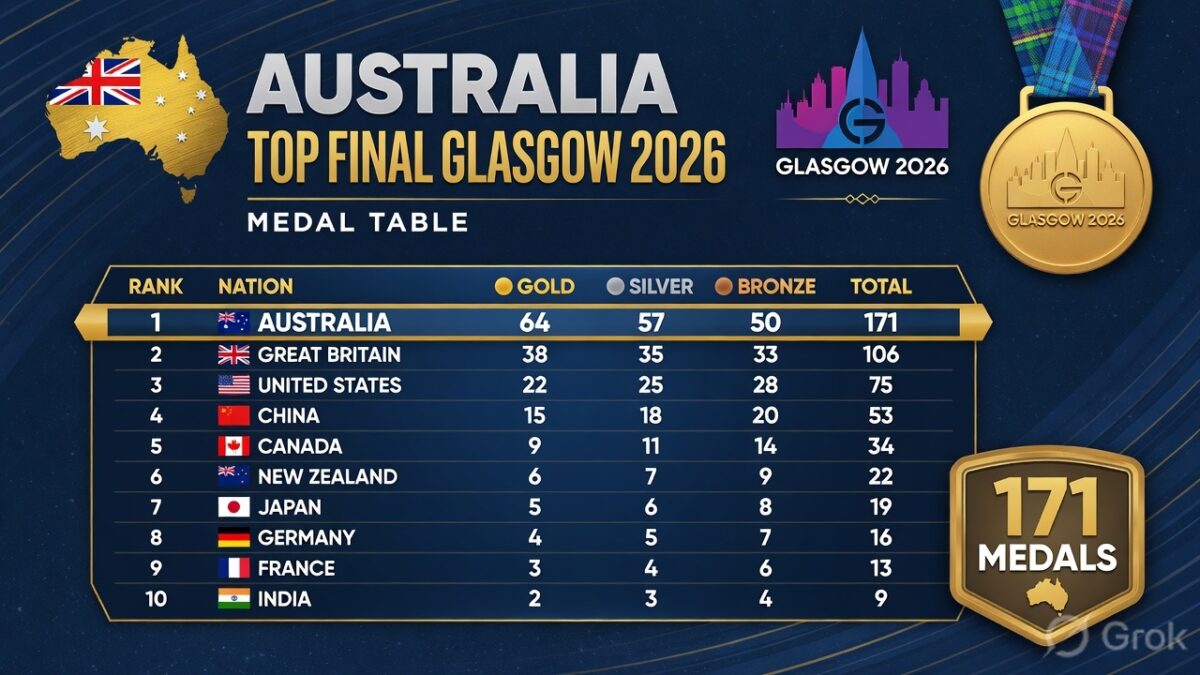
Australia have finished on top of the Glasgow 2026 Commonwealth Games medal table, closing the eleven days of competition with a commanding haul of 171 medals across the ten-sport programme. It is a result that confirms the nation’s status as the dominant force in Commonwealth sport, extending a run of table-topping performances that stretches back across recent editions.
A Familiar Green and Gold Story
Australia’s supremacy was built, as it so often is, in the pool and on the track. Their swimmers set the tone early with a flood of records that had been building since the opening days in Glasgow, and the athletics programme kept the momentum going through the second week. By the time the Australian pool dominance had run its course, the rest of the field was left competing for the places behind them.
The depth of the squad told the real story. Australia did not simply rely on a handful of headline names; they scored across disciplines, from track and field to cycling, from the pool to the combat and team sports. That breadth is what separated them from the chasing nations and turned an early lead into an unassailable margin by the final weekend.
England and Canada Complete the Top Three
England finished second with 110 medals, a total that reflected a determined campaign and one of their strongest showings at a Games held away from home. Their charge had been evident throughout the fortnight, and although they could never quite close the gap to Australia at the summit, they comfortably held off the rest of the Commonwealth to secure the runner-up spot.
Canada took third place with 62 medals, capping a Games that saw them surge up the standings with strong performances in gymnastics, the pool and the combat sports. For a nation that arrived in Glasgow with genuine ambitions of a top-three finish, delivering exactly that represented a job well done.
A Streamlined Games Delivers
Glasgow 2026 was a deliberately slimmed-down edition, with athletes from 74 nations and territories competing across a compact programme of ten sports. The reduced footprint was a response to the financial and logistical pressures that have challenged the Commonwealth Games movement in recent years, and the Scottish host city was praised for stepping in to keep the event alive.
Rather than diminishing the competition, the tighter format arguably sharpened it. Venues were busy, medal events came thick and fast, and the concentrated schedule kept the drama flowing from the first morning to the closing weekend. The final table, topped by Australia and anchored by strong showings from England, Canada and the home nations, gave the Games a fitting competitive shape.
What the Numbers Mean
For Australia, 171 medals is more than a statistic; it is a statement of a high-performance system operating at full strength across almost every sport on the programme. The result will feed naturally into their preparations for the next Olympic cycle, where many of the same athletes will carry their form onto a bigger stage.
For the nations behind them, the table offers both encouragement and a target. England’s runner-up finish and Canada’s podium place show that the competitive middle of the Commonwealth remains healthy, while the emergence of medal winners from smaller nations underlined the breadth that gives the Games its character.
As the Commonwealth Games flag was lowered in Glasgow, Australia could reflect on a fortnight in which they were rarely troubled at the top. The final medal table is theirs, emphatically, and the challenge now passes to their rivals to close the gap before the movement gathers again.




Leave a Reply