
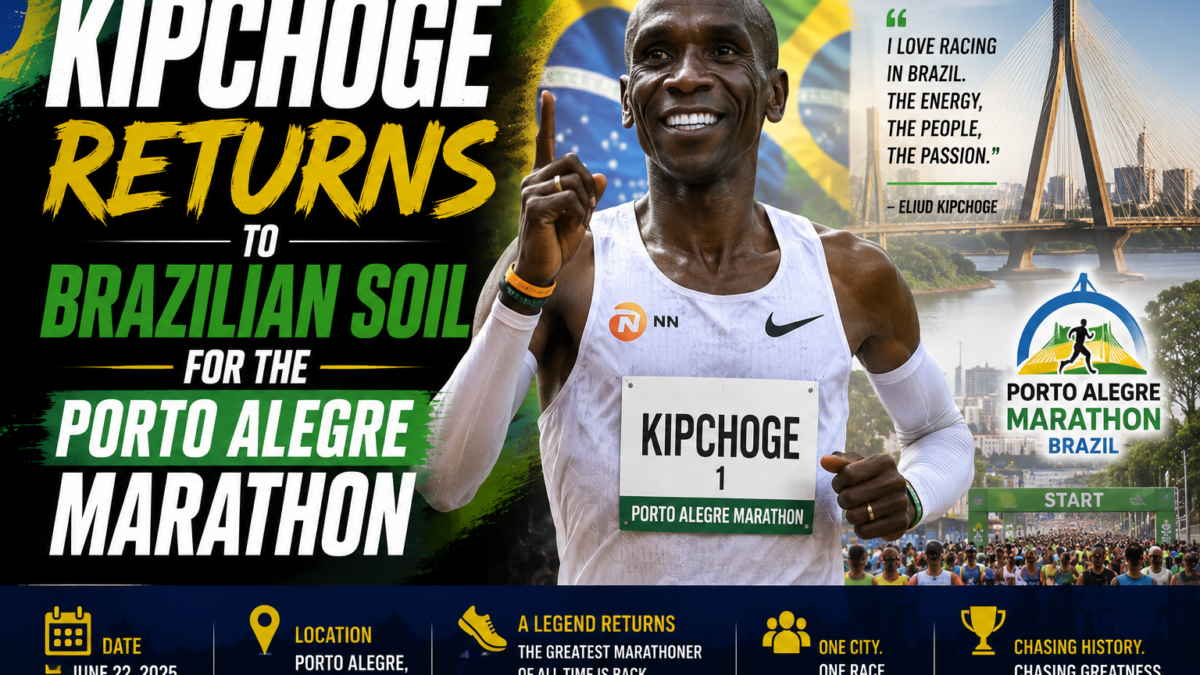
Ten years after the night in Rio that crowned him Olympic champion, Eliud Kipchoge is racing in Brazil again. The marathon great lines up at the Porto Alegre Marathon on Sunday, the second stop of 2026 in his project to run marathons on all seven continents, and a homecoming of sorts to the country where he won the first of his two Olympic titles in 2016.
Brazil Remains in My Heart
Kipchoge has spoken warmly of his connection to Brazil ahead of the race, and the affection is mutual. His winning time of 2:08:44 from the Rio 2016 Olympic marathon still stands as the fastest marathon ever run on Brazilian soil, a mark that has survived a decade of racing. Organisers in Porto Alegre have assembled what is being described as the biggest marathon in Brazilian history, with record fields and prize money drawn by the presence of the sport’s greatest figure.
This appearance continues the new phase of his career that Kipchoge described when announcing his Brazil return earlier this month, one measured in connection rather than records. He has been clear that he is not in Porto Alegre to chase fast times or flirt with the two-hour barrier, but to celebrate running with the people who cheered him a decade ago and to spend five days among Brazilian fans.
The Seven-Continent Mission
The Porto Alegre start is another step in a remarkable second act. Having won everything the sport offers, including back-to-back Olympic golds in Rio and Tokyo and world records that redefined the marathon, Kipchoge has reimagined his role as a global ambassador for running. The seven-continent project takes him beyond the traditional major-marathon circuit to places elite champions rarely race.
There is purpose beyond the symbolism. Kipchoge aims to raise one million dollars for the Eliud Kipchoge Foundation, which supports education and environmental causes in Kenya and beyond. Every start on the tour doubles as a fundraising platform, converting his fame into classrooms and conservation.
A Legacy Still Being Written
At 41, Kipchoge no longer measures himself against the clock, yet his influence on the sport has arguably never been greater. Race organisers report entry surges wherever he appears, and a generation of runners across Africa, Europe and now South America cite him as the reason they took up the marathon.
Rio gave Kipchoge an Olympic title and Brazil a memory to treasure. Porto Alegre offers something different: a chance to see the greatest of all time not chasing history, but sharing it. However fast he crosses Sunday’s finish line, the fastest marathon on Brazilian soil already belongs to him, and so, it seems, does a permanent place in Brazilian running hearts.




Leave a Reply