
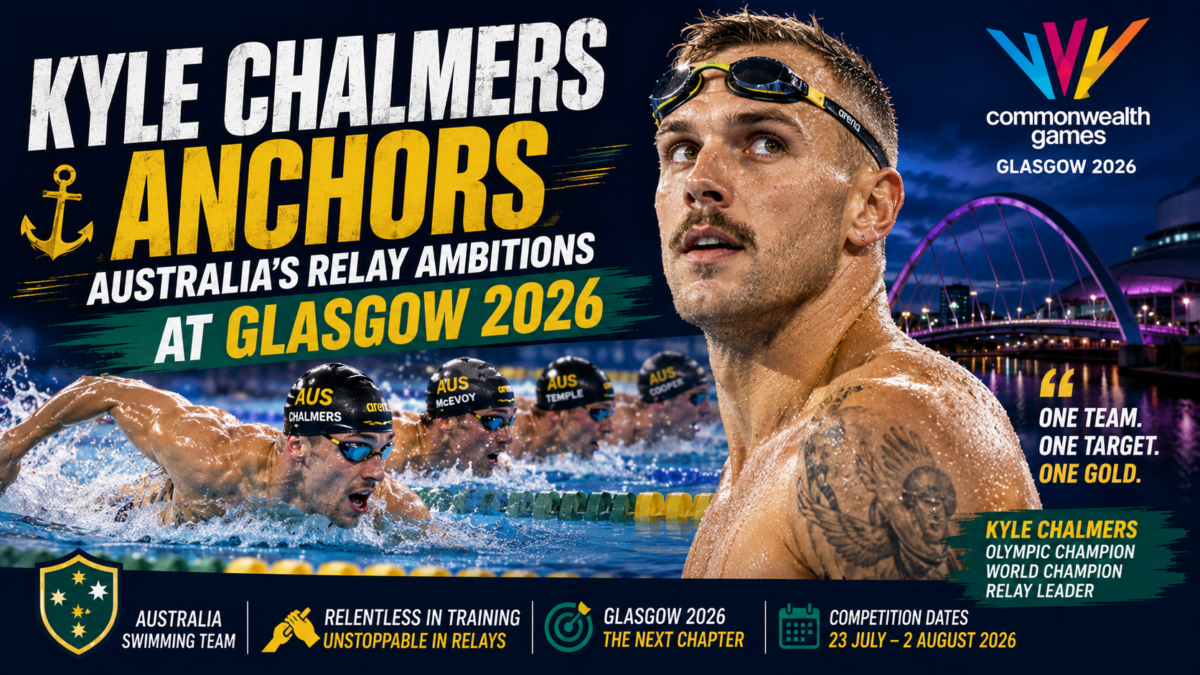
A Sprint King in Glasgow
When Australia’s men lined up for the 4x100m freestyle relay on the opening night of the Glasgow 2026 swimming program, they did so with one of the sport’s most reliable sprinters leading the way. Kyle Chalmers, a seven-time Commonwealth Games gold medallist and the defending 100m freestyle champion, brings a wealth of major-Games experience to a Dolphins squad intent on ruling the pool once again. His presence anchors both the relay effort and the wider ambitions of a team chasing gold across the sprint events.
Chalmers has been a fixture at the sharp end of world sprinting for the better part of a decade, a swimmer whose blistering back-half speed has decided countless races in the closing metres. That finishing power makes him a natural anchor, the man a team wants in the water when a relay comes down to the final touch, and Australia will lean on his experience as they build toward the individual events.
Australia’s Relentless Depth
The Dolphins arrived in Glasgow with a 60-strong squad and a clear objective: to match or better the extraordinary haul of pool golds they claimed at Birmingham 2022. Relays are where that depth is most visible, requiring not one star but four swimmers capable of holding a searing pace. Australia’s production line of sprint talent gives them options few nations can match, and the relays are consequently among their strongest medal prospects.
Chalmers occupies a senior role in that ecosystem, a mentor to younger teammates as much as a competitor. His willingness to lead relay efforts, sharing the load of expectation, reflects the team-first culture that has underpinned Australian swimming’s sustained success.
The Defending Champion’s Challenge
As the reigning Commonwealth 100m freestyle champion, Chalmers faces the perennial challenge of the hunted rather than the hunter. Sprint freestyle is a young person’s event as much as an experienced one, and each Games brings a fresh wave of contenders eager to dethrone the established order. Chalmers has answered such challenges before, but the margins in one-lap racing are unforgiving, and defending a title demands both physical peak and mental steel.
His pursuit of further Commonwealth glory unfolds alongside the ambitions of teammates such as Lani Pallister, whose own distance treble bid headlines the women’s program. Together they form the spine of an Australian effort that treats the Commonwealth pool as a stage on which to reaffirm the nation’s swimming pedigree.
The Value of Experience
In a sport that increasingly prizes youth, Chalmers represents the enduring worth of experience. He has raced in the most pressurised environments the sport can offer and emerged with medals and composure intact, and that hard-won knowledge is precisely what steadies a relay quartet when the margins narrow. Younger teammates learn from watching how he prepares, how he manages the nerves of a final and how he delivers when it counts. That mentorship is an intangible but vital component of a successful program, ensuring that the culture of excellence is transmitted from one generation to the next. Australia’s continued dominance owes as much to figures like Chalmers as to the raw talent constantly emerging through its ranks.
Building Toward Bigger Targets
For Chalmers and Australia, Glasgow is both an end in itself and a waypoint on a longer journey. The rhythms of a major-Games meet, the relays and finals and the pressure of racing for a nation, provide invaluable preparation for the events that will define the road to Los Angeles 2028. The Dolphins’ focus on relay strength, evident across their roster planning much like Canada’s assembling of a deep squad for the Pan Pacs, speaks to a program thinking several moves ahead.
On the opening night, with Chalmers in the water, Australia signalled that their era of pool dominance is far from over. The sprint king remains central to the plan, and the Commonwealth Games once again became a showcase for the depth and quality of Australian swimming.


Leave a Reply