
Grit and Gold in Glasgow
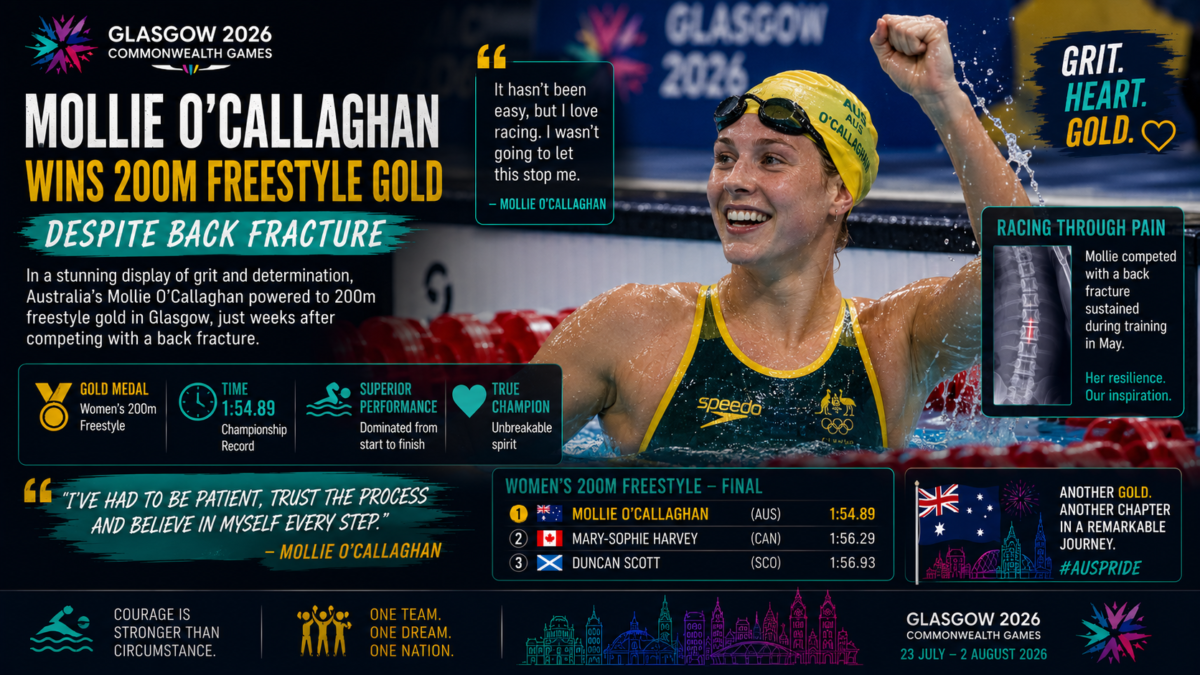
Some victories are measured in seconds, others in the obstacles overcome to earn them. Mollie O’Callaghan’s win in the women’s 200m freestyle at the Glasgow 2026 Commonwealth Games belonged firmly to the second category. Racing with a stress fracture in her back, the Australian summoned her trademark closing speed to touch first in 1:54.66 and add another gold to her glittering collection.
The finish was pure O’Callaghan. Having positioned herself within striking distance, she unleashed a devastating final 50 metres, splitting 29.32 to win by 0.35 seconds. In a race that pitted her against elite company, it was that closing burst that made the difference and confirmed her status as one of the finest 200m freestylers in the world.
An All-Australian Battle at the Front
The podium underlined Australia’s depth in the event. O’Callaghan’s teammate Lani Pallister pushed her all the way, taking silver in 1:55.01, while New Zealand’s Erika Fairweather claimed bronze in 1:55.24. For Pallister, billed before the Games as a swimmer ready to lead Australia's pool charge, the silver was further evidence of her rise, even as O’Callaghan denied her at the last.
That two Australians filled the top two places in a race of this quality speaks to a programme operating at a level few can match. The internal competition within the Dolphins squad is fierce, and it is precisely that pressure that keeps producing world-class times when it matters most.
Racing Through the Pain
The context of O’Callaghan’s swim made it all the more impressive. Competing with a back injury that would sideline many athletes, she chose to race and then found a way to win. It was a display of resilience that will resonate well beyond Glasgow, a reminder that champions are often defined as much by what they endure as by what they achieve.
Her decision to compete carried risk, but the reward was a gold medal that adds to a résumé already decorated with Olympic and world titles. Managing the injury across a busy Commonwealth programme will be a delicate balancing act, yet the 200m freestyle victory suggests she has both the form and the fortitude to navigate it.
Depth That Defines a Dynasty
O’Callaghan’s win slotted neatly into a broader story of Australian control in the Glasgow pool. From the sprint relays to the individual events, the Dolphins have set an early standard, and their strength in the middle-distance freestyle races is a particular weapon. The 200m freestyle result mirrored the dominance seen when Australia broke the mixed relay record earlier in the meet.
For rivals, the challenge is daunting. Beating one Australian in a final is hard enough, but the nation routinely qualifies two genuine contenders, forcing opponents to overcome a wall of green and gold. That depth is the foundation of a swimming dynasty that shows no sign of loosening its grip.
Eyes on the Rest of the Meet
With the 200m freestyle secured, attention turns to how O’Callaghan manages her body across the remaining days. Relay commitments and further individual chances beckon, and the injury will demand careful handling. Whatever she chooses, she has already delivered one of the standout swims of the Games.
As Glasgow 2026 progresses and the swimming programme reaches its climax, O’Callaghan’s gutsy 200m freestyle gold will be remembered as a portrait of a champion refusing to yield. Pain and all, she found the wall first, and in doing so reaffirmed her place at the summit of world swimming.
Her win also served as a case study in race management for the aspiring swimmers watching on. O’Callaghan rarely leads from the front, preferring to stalk her rivals before striking late, and the 200m freestyle showcased that patience perfectly. Combined with the mental toughness required to race through injury, it was a performance that offered lessons as much as it delivered a medal, and it left little doubt about her championship credentials.


Leave a Reply