
The Last African Standard-Bearers
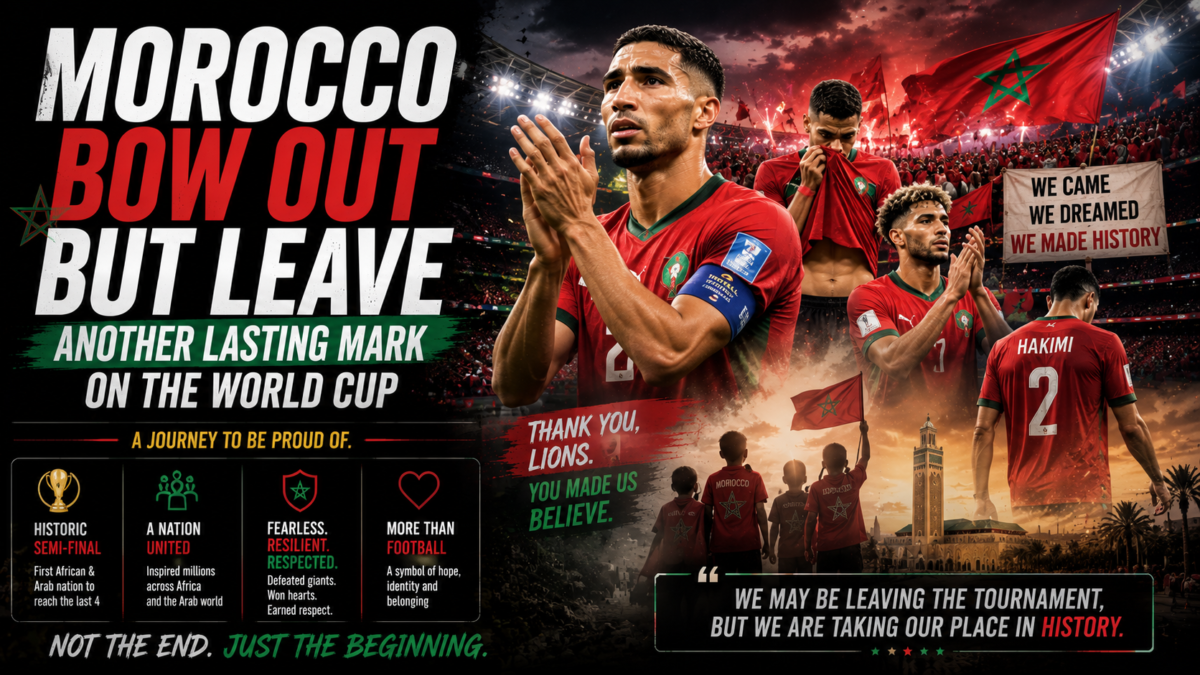
Morocco’s 2026 World Cup ended in a 2-0 quarterfinal defeat to France in Boston, and with it went the last African challenge of the tournament. But if the scoreline told the story of one night, it did not tell the story of a month in which the Atlas Lions once again carried a continent’s hopes deep into the knockout rounds — and confirmed that their historic 2022 semifinal run was no accident.
Four years after becoming the first African side to reach a World Cup semifinal in Qatar, Walid Regragui’s successors proved that Morocco now belong among the tournament’s established powers. Back-to-back quarterfinals across two World Cups is a record most European football nations would envy, and no African side has ever sustained this level across consecutive tournaments.
A Run Built on Nerve
This summer’s campaign had everything that has come to define modern Morocco. There was the trademark defensive resilience and a goalkeeper in Yassine Bounou who once again performed heroics, most memorably in the shootout win over the Netherlands that announced Morocco’s arrival in the knockout stage. There was ruthlessness too: the 3-0 dismantling of co-hosts Canada in the round of 16 was as complete a knockout performance as any side produced this tournament.
Against France, the formula finally met an opponent with too much quality. Bounou saved a Kylian Mbappe penalty and kept the tie level for an hour, but France’s expected-goals dominance eventually told. There was no collapse and no shame — just a better team on the night, as France’s own third consecutive semifinal confirms.
Africa’s World Cup Grows Stronger
Morocco’s exit closes a World Cup in which African football’s depth was impossible to ignore. Egypt won their first-ever knockout match, Ghana and Senegal pushed deep into the tournament, and Cape Verde's fairytale run captured hearts before Argentina ended it. The expanded 48-team format gave the continent more representatives than ever, and the results largely justified them.
For Morocco specifically, the future remains bright. The core of this squad blends survivors of the 2022 run with a generation raised on its example, and the 2030 World Cup — which Morocco will co-host with Spain and Portugal — now sits on the horizon as the obvious target. A home World Cup, with a team that has reached consecutive quarterfinals, is the kind of opportunity nations wait a century for. The Atlas Lions leave this tournament with heads high and a clear mission: turn near-misses abroad into history at home.



Leave a Reply