
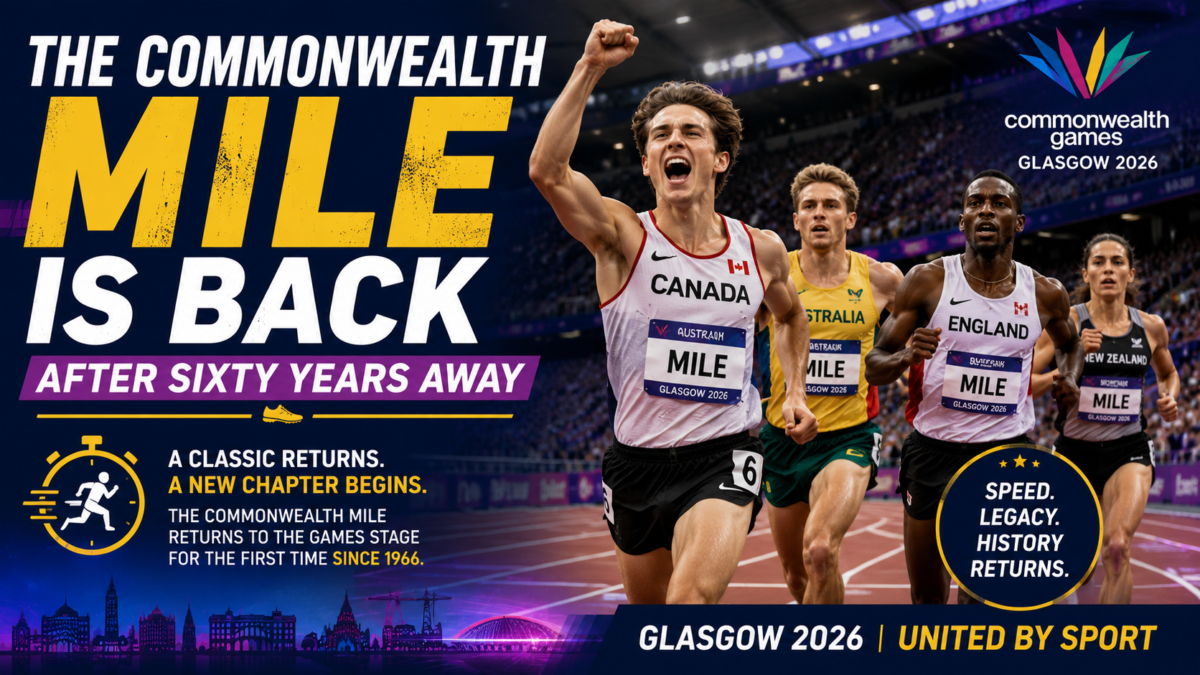
The 1500m has been quietly removed from the Commonwealth Games athletics programme and replaced by something older, stranger and considerably more romantic. When the middle-distance runners line up at Scotstoun Stadium next week they will be racing a mile, an event that has not appeared at these Games since Kingston in 1966.
An event with a mythology
From 1930 through to 1966, the mile was the blue riband event of the Commonwealth Games, the race that defined each edition. Its most famous moment came in Vancouver in 1954, when Roger Bannister of England and Australia’s John Landy, at that point the only two men on earth to have run under four minutes, met head to head just two months after Bannister broke the barrier. The race that followed is still known simply as the Miracle Mile, and it did more to fix the Commonwealth Games in the public imagination than any medal table ever has.
Then metrication arrived and the mile disappeared from championship programmes, surviving only in road races, Diamond League one-offs and the collective affection of anyone who ever tried to run one. Bringing it back is a piece of deliberate nostalgia, but it is also a shrewd bit of event design. The mile is the one distance that non-specialists understand instinctively. Four minutes is a number people can hold in their heads in a way that 3:30 for 1500m simply is not.
Kerr, Gourley and a home crowd
The timing is almost absurdly good for Scotland. Josh Kerr broke the mile world record in London only days ago, running 3:42.66 to erase a mark that had stood for 27 years, and he now walks into a home Games with the event restored to the programme and his name at the top of the all-time list. Neil Gourley, his compatriot and training rival, has also spoken about how much the format appeals to him. Both are part of a Team Scotland athletics squad that also features Eilish McColgan and carries genuine medal expectation on home soil.
A world record holder racing a resurrected blue riband event in his own city, in front of a crowd that has waited twelve years for this, is the sort of scenario organisers usually have to invent. Glasgow got it for free.
Not the only change
The mile is not the only addition. The mixed 4x400m relay, now an Olympic staple, joins the programme for the first time, giving the athletics timetable a genuine team finale. Between them the two new events signal an athletics programme built for television and for a live crowd rather than for the record books, which is a reasonable priority for a Games trying to prove that a leaner model can still be compelling.
Athletics and Para athletics run as a combined programme at Scotstoun from Monday 27 July across six days, with nearly 60 medal events including a record 16 for Para athletes. That integration is a genuine point of difference for the Commonwealth Games and something the Olympic movement has never attempted at the same scale.
The risk and the reward
There is a case against all this. The mile is not an Olympic event and never will be, which means the winner in Glasgow claims a title that does not translate directly to a global pathway, and athletes chasing LA28 qualification standards may find the distance an awkward fit in a packed season. World Athletics ratifies mile records but championship medals in the distance now exist essentially nowhere else.
That objection assumes every race has to serve a larger purpose. The counterargument is simply that the mile is a better spectacle, that the Commonwealth Games has always been a place for events that do not exist elsewhere, and that reviving the race which produced the Miracle Mile is exactly the kind of thing a Games with limited resources should be doing to distinguish itself.
Organisers have even launched a Commonwealth Mile route through the city to accompany the track event, a nod to mass participation that fits the broader tone of these Games. On the evidence of the last few weeks, they will get their money’s worth at Scotstoun.



Leave a Reply