
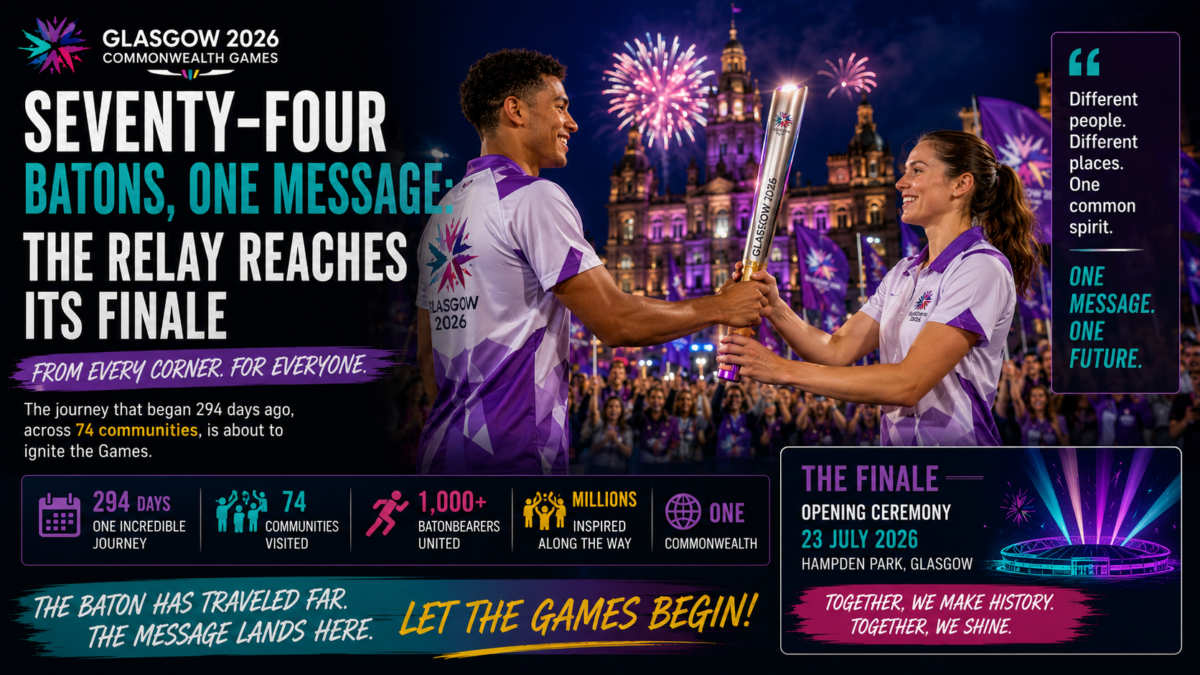
Every Commonwealth Games opens the same way and never quite the same way twice. A baton that has spent months circling the globe arrives in the host stadium, a message is read aloud, and the Games are declared open. On Thursday evening at the Hydro in Glasgow, that ritual will be performed with a twist that has never been tried before.
A relay redesigned
For the first time in the history of the event, every Commonwealth nation and territory received its own baton for local celebrations rather than waiting for a single object to pass through. Seventy-four batons have been travelling simultaneously through their own communities, carried by local heroes in places that would otherwise have had a few hours of the relay at most, or been skipped entirely.
All seventy-four will be reunited on the floor of the Hydro at the opening ceremony. It is a striking piece of staging and a smart response to a practical problem. The traditional single-baton relay is a logistical monster, requiring years of planning, enormous travel budgets and a route that inevitably favours larger nations over smaller ones. Splitting the relay into seventy-four parallel journeys made it cheaper, greener and, crucially, more democratic. A territory with a population of a few thousand got the same object, the same photographs and the same civic moment as one with hundreds of millions.
The message in the tube
The heart of the ceremony remains unchanged. The King placed a written message inside the King’s Baton on Commonwealth Day at Buckingham Palace in March 2025, and neither the contents nor the wording have been made public since. On Thursday he will read it aloud in front of an arena audience, and the reading is the moment Glasgow 2026 becomes officially open.
There is something quietly effective about a ceremony whose climax is a piece of paper being read out. In an era of drone displays and pyrotechnic budgets, the baton message survives because it does something spectacle cannot, which is to place a specific human voice at the centre of a very large occasion. The King and Queen will both attend, and their presence has been confirmed since organisers announced the ceremony lineup earlier this month.
Glasgow, twelve years on
The city has been here before, and recently enough that the comparison is unavoidable. Glasgow 2014 is remembered fondly in Scotland as a Games that punched above its weight, and 2026 arrives under very different circumstances. This edition was assembled at speed after Victoria withdrew as host, stripped back to ten sports across a compact cluster of venues, and delivered on a fraction of the budget that recent Games have required.
Whether that reinvention works is the question hanging over the next eleven days. What is already clear is that Glasgow has decided to enjoy itself regardless, with bars, cafes and cultural venues across the city leaning into the occasion, and athletes arriving in a steady stream to be met by volunteers in purple. Nearly 3,000 competitors from 74 nations and territories will contest more than 200 gold medals between Thursday and 2 August.
What the ceremony has to do
Opening ceremonies carry an unfair burden. They are expected to summarise a nation, entertain a global broadcast audience, move an arena full of athletes and stay within a running time, all at once. Glasgow’s has an additional job, which is to make the case that a smaller, cheaper Commonwealth Games is a legitimate version of the event rather than a diminished one.
The seventy-four batons are, in that sense, the perfect emblem. They exist because the old model was too expensive and too centralised, and the solution turned out to be better than the thing it replaced. If the rest of Glasgow 2026 manages the same trick, the Commonwealth Games may have found a way to keep going. The first medal, unusually, will be decided the following day in Para powerlifting. But the story starts on Thursday night, with a baton, a letter and a city that has done this before.


Leave a Reply