
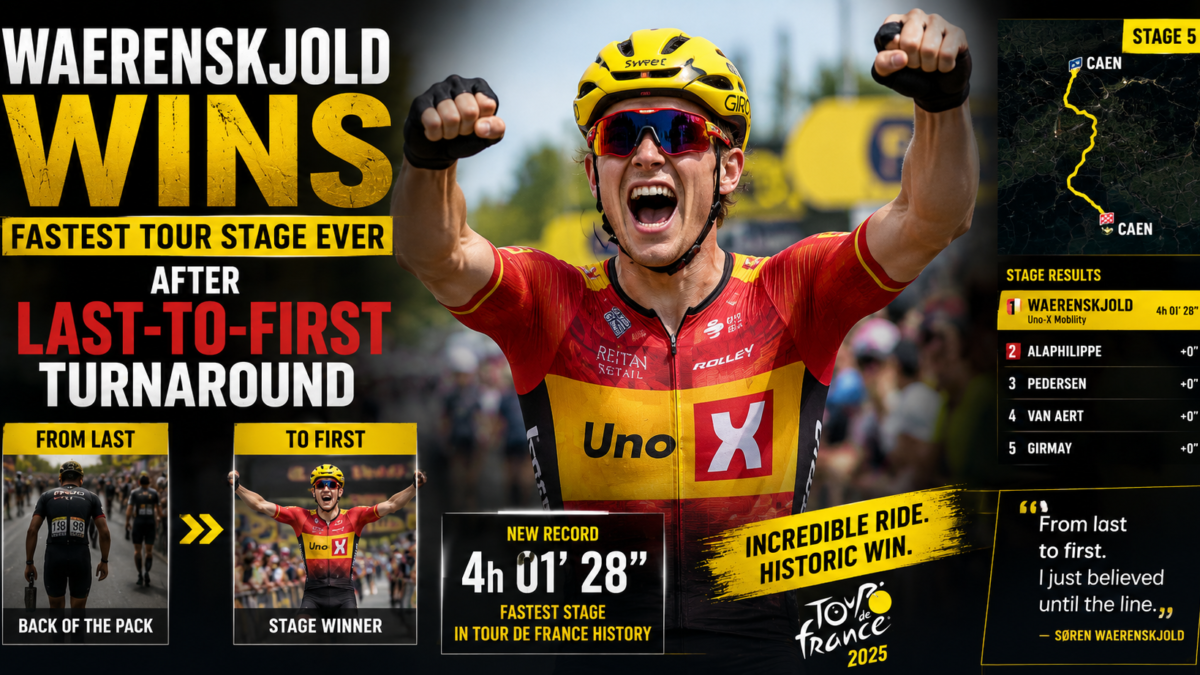
The Tour de France produced one of its great redemption stories on Wednesday, and it happened at record speed. Soren Waerenskjold, who trailed home dead last at Le Lioran barely 24 hours earlier, won Stage 11 in Nevers in what has been measured as the fastest road stage in Tour history, a last-to-first turnaround that left the peloton’s established sprinters chasing shadows.
From the Broom Wagon’s Shadow to the Podium
Waerenskjold’s Tuesday could scarcely have gone worse. Distanced on the climbs to Le Lioran, the big Norwegian rolled in at the very back of the race, his thoughts presumably already on survival rather than glory. What followed in Nevers was the kind of reversal that gives cycling its romance: a perfectly timed surge in the finale of the 161.3-kilometre run from Vichy to claim the biggest win of his career.
The stage was billed as a routine sprint day, but it unfolded at a ferocious pace from the start on wet roads around Vichy. Mathieu van der Poel launched the day’s first attack, and a determined breakaway featuring Julian Alaphilippe, Mathis Le Berre, Nelson Oliveira and Anthon Charmig forced the sprint teams to burn matches all afternoon. Soudal-QuickStep, working for Tim Merlier and a possible hat-trick of stage wins, controlled much of the chase, but when the race funnelled into Nevers it was Waerenskjold who found the fastest line, denying Merlier, Jasper Philipsen, Biniam Girmay and Olav Kooij in the dash to the line.
The Fastest Stage Ever Ridden
The relentless speed had a historic byproduct: the stage went into the books as the fastest in the Tour’s 123-year history. Tailwinds, smooth roads and the sheer horsepower of a modern WorldTour peloton combined to push the average speed beyond anything the race had previously recorded, a mark that says as much about the evolution of equipment, nutrition and training as it does about Wednesday’s racing.
For Norway, the win extends a golden sporting summer. Weeks after Erling Haaland carried the national football team on a historic World Cup run, Waerenskjold delivered Norwegian cycling a marquee triumph on the sport’s biggest stage, further evidence of a small nation punching far above its weight across disciplines.
Pogacar Untroubled in Yellow
Among the general classification contenders, the day passed without damage. Tadej Pogacar finished safely in the bunch to retain the yellow jersey at 39 hours, 25 minutes and 8 seconds of accumulated racing, preserving the commanding advantage of 3 minutes and 36 seconds over Jonas Vingegaard that he carried into the race's first rest day. The Slovenian’s team rode with characteristic control, content to let the sprint teams shoulder the pacemaking on a day that posed no threat to the standings.
The truce will not last. The race now tilts toward the mountains, where Vingegaard must find more than three and a half minutes on a rival who has looked untouchable through the opening third of the race. Every flat stage that passes without incident is another day closer to a fifth Tour title for Pogacar, and the Dane’s window for ambush is narrowing.
A Reminder of Cycling’s Charm
Stage 11 will be remembered less for the general classification than for its human story. Bike racing is unsparing to sprinters in the mountains; the same riders who fight for glory on the flat must simply survive when the road climbs. Waerenskjold’s 24-hour journey from last man on the road to stage winner is that cruelty and that charm compressed into two afternoons, and a reminder that in the Tour de France, no rider’s race is ever quite finished.



Leave a Reply