
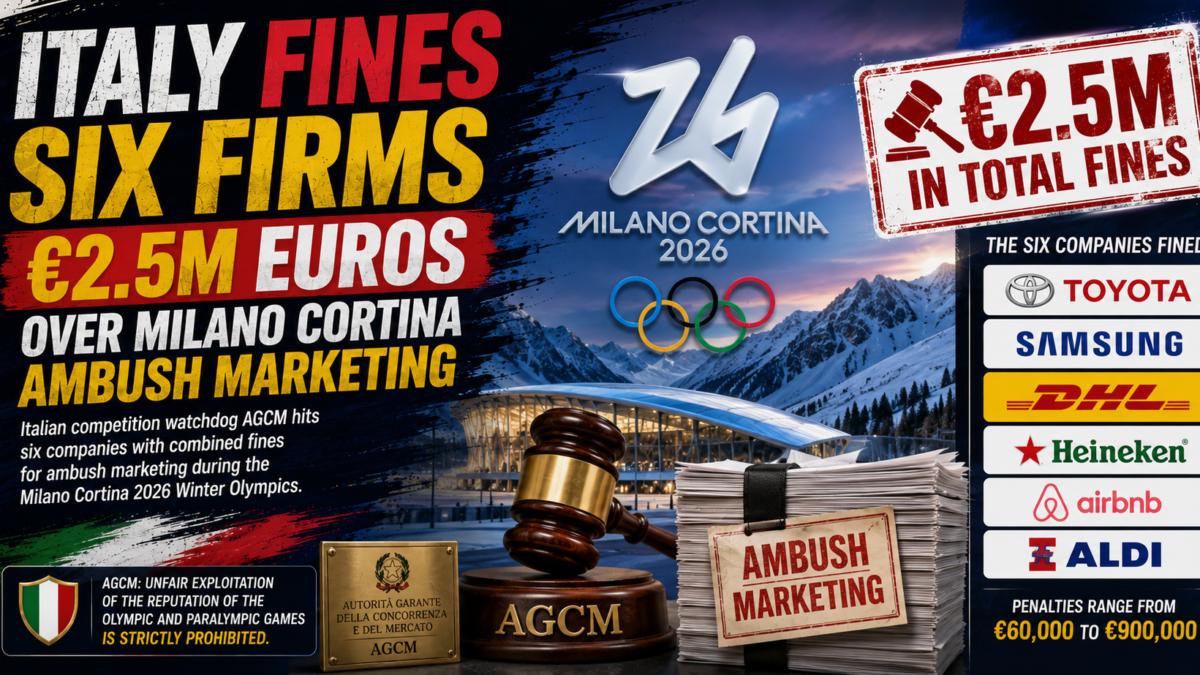
Italy’s competition authority has handed down more than 2.5 million euros in fines to six companies for ambush marketing around the Milano Cortina 2026 Winter Olympic Games, in one of the more forceful enforcement actions taken by any host nation against brands trading on Olympic association without paying for it.
Who Was Fined and How Much
The AGCM, Italy’s antitrust and consumer protection watchdog, targeted a varied group. Fashion brand Harmont and Blaine was among them, alongside four supermarket chains, Il Gigante, MD, Oasi and Pro7, and the gas supplier ButanGas.
Pro7 received the heaviest penalty at 550,000 euros. Harmont and Blaine and Oasi were each fined 500,000 euros, followed by ButanGas at 350,000, Il Gigante at 310,000 and MD at 300,000. The combined figure comfortably exceeds 2.5 million euros.
The authority’s finding was that each company ran advertising campaigns deploying Olympic symbols, including the five rings, and official naming such as Milano-Cortina 2026, without holding any sponsorship rights. The consumer harm identified was misleading customers into believing these businesses were official partners of the Games when they were not.
The Defences, Which Did Not Work
Some of the responses were more inventive than persuasive. Oasi argued that the overlapping coloured rings appearing in its campaign did not infringe any intellectual property because they were intended to resemble carnival garlands. Il Gigante contended that its campaign was a harmless pun constructed to sell televisions rather than an attempt to imply Olympic endorsement.
Neither argument survived contact with the regulator. The AGCM’s position, consistent with how ambush marketing rules are generally applied, is that the test is what an ordinary consumer would reasonably infer from the advertising, not what the advertiser claims to have intended. Five overlapping rings in an Italian shop window in the run-up to an Italian Winter Olympics carry an obvious meaning regardless of any stated carnival theme.
Why Host Nations Take This So Seriously
The commercial architecture of the modern Olympic movement rests on exclusivity. Sponsors pay substantial sums precisely because the association is restricted, and if that association can be approximated for free by any retailer willing to print five circles on a leaflet, the value of the paid rights collapses. Host countries typically pass dedicated ambush marketing legislation as a condition of hosting, and Italy’s framework has been in place since well before the Games arrived.
The scale of what is being protected is considerable. Olympic sponsorship underwrites a large share of the revenue that the IOC redistributes to national committees and international federations, which in turn funds athlete programmes in sports that generate little commercial income of their own. The enforcement action is, in a fairly direct sense, a defence of that funding chain.
A Warning Shot for Future Hosts
The timing is instructive. Milano Cortina staged its Games in February 2026, and these fines have landed months afterwards, which is characteristic of how such investigations proceed. Regulators gather evidence during the event window and issue decisions once the tournament has passed.
Organisers of forthcoming Games will have taken note. Los Angeles 2028 operates in a legal environment where Olympic marks enjoy unusually strong statutory protection in the United States, and the Glasgow 2026 Commonwealth Games have their own brand protection regime. The pattern across all of them is the same: aggressive early warnings to local businesses, followed by selective enforcement against the clearest offenders.
The Grey Zone Remains Grey
None of this fully resolves where the line sits. Brands routinely run campaigns that evoke the atmosphere of a major sporting event without using any protected mark, congratulating national teams in general terms or simply advertising heavily during the relevant weeks. That behaviour is legal and unlikely to attract enforcement.
What the Italian decisions clarify is the outer boundary. Using the rings themselves, or the official event name, without rights is not a grey area and will not be treated as one, however creatively the resulting campaign is later characterised. Six companies have paid a considerable amount of money to establish the point for everyone else.




Leave a Reply