
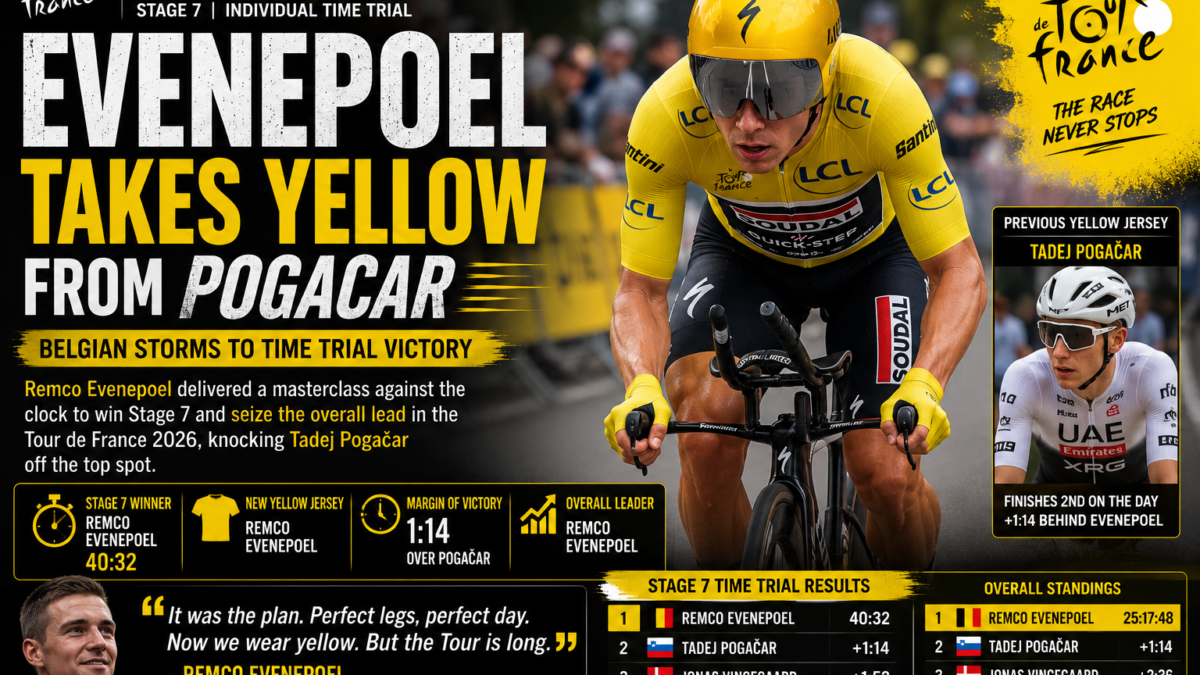
The Tour de France has a new leader, and for the first time in this edition the race no longer looks like a procession. Remco Evenepoel won the stage 16 individual time trial between Evian-les-Bains and Thonon-les-Bains on Tuesday, beating Tadej Pogacar by 28 seconds over 26.1 kilometres and taking the yellow jersey off the defending champion’s shoulders by exactly that margin.
The specialist does what specialists do
There was never much mystery about who would win a flat individual time trial in this field. Evenepoel is the Olympic time trial champion and a former world champion in the discipline, and a 26-kilometre run along the shore of Lake Geneva was as close to a tailor-made stage as the route designers could have offered him. The question was only ever how much time he could take, and whether it would be enough.
He rode it with the controlled aggression that has become his signature, pacing the opening kilometres conservatively before opening up on the flatter middle section. Pogacar, no slouch against the clock himself, was second at 28 seconds. Denmark’s Mattias Skjelmose took third, a full minute and four seconds down, which puts the gap between the top two and the rest of the race into perspective.
A general classification turned upside down
The mathematics are now brutally simple. Evenepoel leads Pogacar by 28 seconds with five stages remaining, and the Slovenian has spent this Tour looking like a man managing a lead rather than building one. Sunday's stage 15 already hinted that the race was tightening, when Evenepoel won on the Solaison climb while Jonas Vingegaard crashed out of contention entirely, removing the rider most people expected to be Pogacar’s principal threat.
That crash reshaped the race in a way nobody wanted to see but everybody has had to reckon with. Vingegaard’s departure was supposed to hand Pogacar a clear run to Paris. Instead it cleared space for Evenepoel to move into the vacuum, and he has taken it with both hands across four days.
What is left
The remaining stages will decide whether a 28-second buffer is a lead or a rounding error. Pogacar’s strength has always been in the high mountains, where he can turn a small deficit into a large advantage in the space of a single climb, and there is still enough vertical gain left on the route for him to do exactly that. Evenepoel’s task is to limit the damage rather than extend his margin, a defensive posture that does not come naturally to him.
There is also the matter of teams. Pogacar has ridden this Tour with a squad built to control a race from the front, and that structure becomes more valuable, not less, when the leader is chasing. Evenepoel will need his own support to survive the opening slopes of the decisive climbs intact, because if he is isolated early on a summit finish the 28 seconds will evaporate quickly.
Momentum is not nothing
Still, momentum in a three-week race is a real thing, and Evenepoel currently has all of it. He has won two of the last four stages, he has taken the jersey in the discipline he is best at, and he heads into the final week knowing that his rival has to attack rather than defend. Tom Pidcock, who forced his way into the podium conversation earlier in the race, sits further back but remains capable of complicating matters on a hard mountain day.
For the neutral, this is the outcome the Tour needed. A race that briefly threatened to become a coronation now has a genuine duel at its head, between the best all-rounder of his generation and a rider who has spent years being told he was too heavy, too impatient or too fragile for the biggest Grand Tour of all. Whatever happens in the Alps, Evenepoel has already made this a Tour worth arguing about.

Leave a Reply