
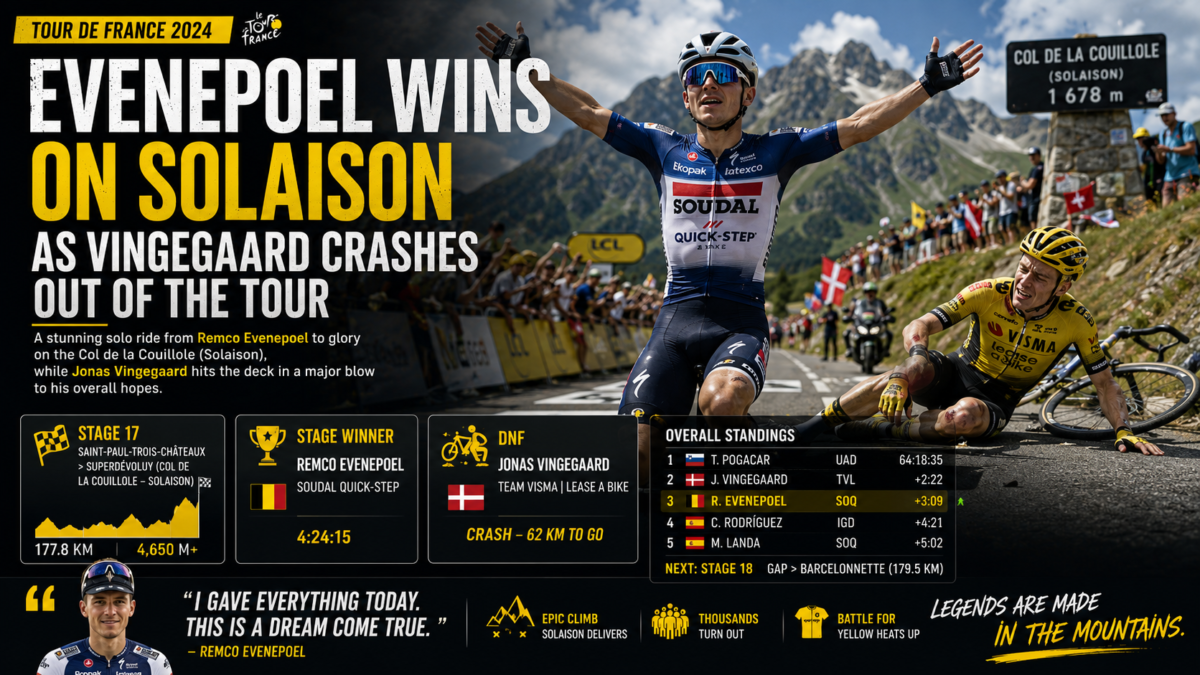
The second week of the 2026 Tour de France closed with the kind of stage that rearranges a race entirely. Remco Evenepoel outmanoeuvred Tadej Pogacar to take the win on the Plateau de Solaison, and by the time the podium ceremony took place the general classification had a new shape, because Jonas Vingegaard was no longer in the race.
The Crash
Vingegaard was lying second overall when he went down roughly twenty kilometres from the summit finish. The Dane, a two-time champion of this race and the only rider in the past half-decade to have consistently beaten Pogacar over three weeks, did not remount to fight for position. He abandoned, and the Tour lost the one rider whose presence had kept the outcome nominally open.
Crashes on descents ahead of mountain-top finishes are among the cruellest features of Grand Tour racing, because they arrive at the moment riders are at their most committed and least protected. For Vingegaard the consequence is a race lost in a matter of seconds after two weeks of holding a title contender’s position.
How the Stage Was Won
Evenepoel’s victory was tactical rather than brutal. On a finishing climb that suited pure climbers, he read Pogacar’s rhythm rather than trying to match every acceleration, and he timed his own effort late enough that the response never fully came. Isaac del Toro, riding in support of Pogacar for much of the day, completed the podium in third.
Beating Pogacar on a summit finish is a rare enough achievement that it changes how Evenepoel will be raced for the remainder of the Tour. He now sits second overall, five minutes behind the yellow jersey, with del Toro third. That is a substantial gap, but it is a gap held by a rider who has just demonstrated he can win a head-to-head sprint at altitude.
What It Means for Pogacar
The uncomfortable truth for Pogacar is that his path to a fifth Tour title just became simultaneously easier and less satisfying. Vingegaard’s abandon removes the rival whose presence gave the previous editions their edge, and it will inevitably colour how this victory is discussed if it arrives in Paris as expected.
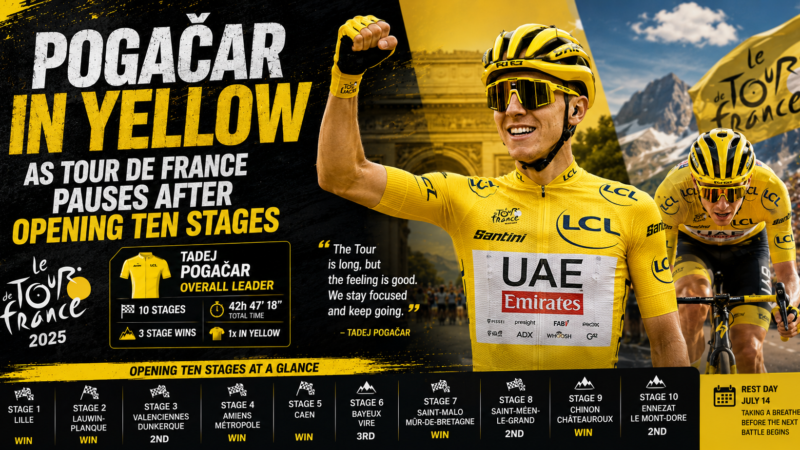
Pogacar has been in yellow since the opening week, and his control of the race has been methodical rather than flamboyant. He came into the Alps with a comfortable buffer built during the opening ten stages, and he leaves the second week with that buffer intact despite conceding the stage. From a purely competitive standpoint, losing a stage while gaining a rival’s withdrawal is an excellent day’s work.
A Race Reshaped
The general classification now reads as a contest for the remaining podium places rather than for the yellow jersey. Evenepoel and del Toro are separated by a margin small enough to be overturned in a single mountain stage or a well-executed time trial, and the closing week offers both.
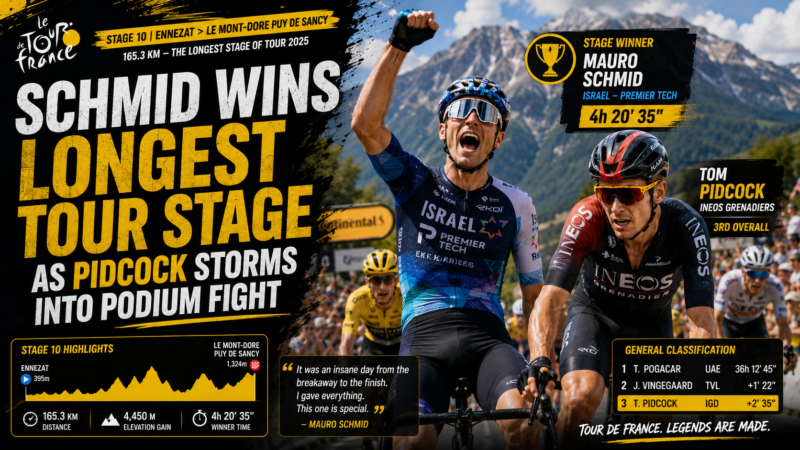
Behind them, riders who spent the first two weeks racing conservatively for top-ten placings suddenly find the door open. Tom Pidcock’s move into podium contention over the longest stage of the race earlier in the week already suggested the classification was less settled than the yellow jersey implied, and Vingegaard’s exit accelerates that.
The Week Ahead
A time trial follows, and it is the discipline in which Evenepoel has historically been strongest. If he can take meaningful time out of del Toro there, the fight for second becomes his to lose. Whether he can take enough out of Pogacar to make the overall interesting again is a different and considerably more ambitious question.
For Vingegaard, the recovery process now begins with no obvious immediate target. Riders who abandon Grand Tours in the second week often return with something to prove, and the rivalry that has defined this era of stage racing does not end with a single crash on a French descent. It simply pauses, awkwardly, at the worst possible moment.

Leave a Reply