
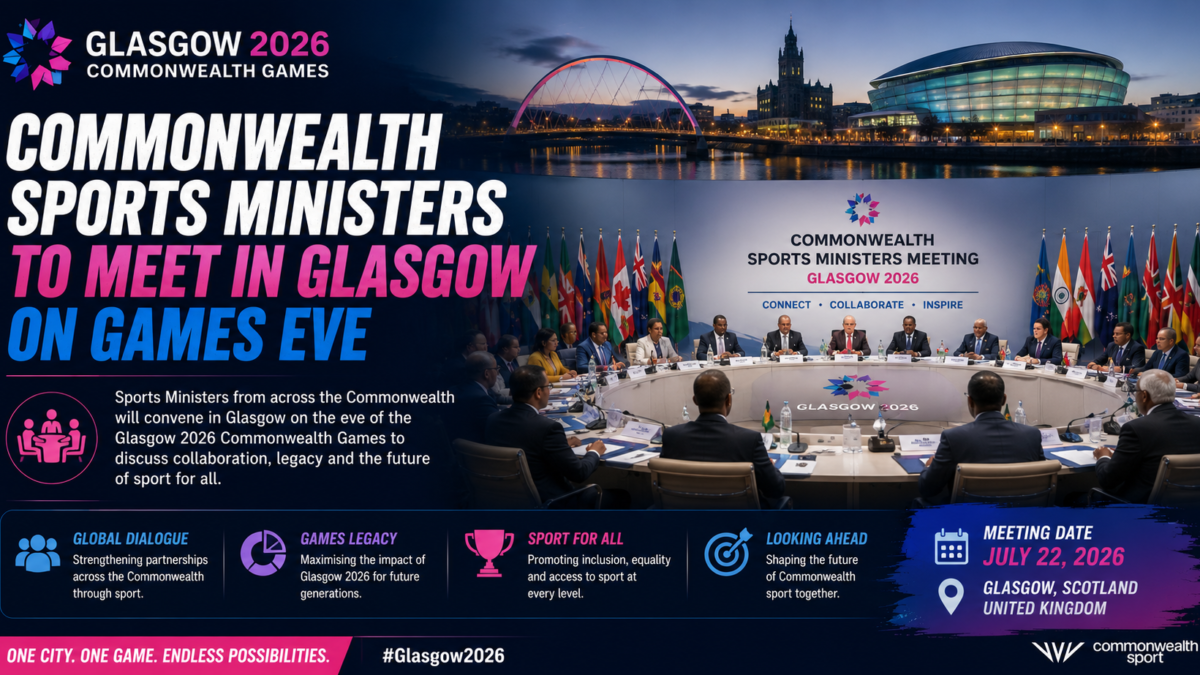
A day before the cauldron is lit at the Hydro, a rather quieter gathering will shape what the Commonwealth sporting movement looks like for the rest of the decade. The 12th Commonwealth Sports Ministers Meeting convenes in Glasgow on 22 July, bringing ministers from across the 56 member countries together on the eve of the Games.
The Theme and the Timing
The meeting runs under the theme “Reimagining the power of sport: towards healthier, fairer and equitable Commonwealth communities,” a formulation that sounds like standard diplomatic language until you consider what has happened to the Commonwealth Games over the past three years. A host city withdrew. The programme was cut. The event that opens on 23 July is a substantially reduced version of what the movement had been staging for decades.
Holding the ministers’ meeting on the eve of that reduced Games is not accidental. Governments that fund national sporting bodies are being asked to decide what the Commonwealth sporting calendar is actually for, and they are being asked in the week when the answer is most visible.
What Is on the Agenda
Ministers will review progress against previously agreed Commonwealth priorities and consider a more structured approach to collaboration across the coming cycle. The framing runs from Glasgow 2026 through the Malta 2027 Commonwealth Youth Games and on to the Commonwealth Games in Amdavad in 2030, which gives the discussion a concrete horizon rather than an open-ended one.
Commonwealth Secretary-General Shirley Botchwey will join ministers alongside sporting partners and global sporting leaders. The stated priorities are broad: how sport can drive progress on health and governance, how it can advance inclusion and gender equality, and how it can attract investment to build more resilient economies through stronger partnerships.
The meeting is chaired by Maree Todd MSP, the Scottish Government’s Minister for Mental Wellbeing, Public Health, Sport, Alcohol and Drugs, which places the host nation directly in the chair for a conversation about the movement’s future.
The Amdavad Question
The most consequential item may be the one that sits furthest down the calendar. Awarding the 2030 Games to Amdavad shifts the centre of gravity of the Commonwealth sporting movement decisively towards India, at a moment when India is simultaneously pursuing a broader set of hosting ambitions. Ministers arriving in Glasgow will be aware that the decisions taken about programme structure, funding models and athlete pathways over the next four years will largely determine whether 2030 is a revival or a continuation of managed decline.
That question hangs over the Glasgow programme itself. The decision to cut sports including wrestling, badminton and cricket reshaped the competitive landscape for several nations, India most obviously among them, and reduced what had been a nineteen-sport Games to ten. Whether that reduction becomes the new baseline or a one-off response to circumstance is exactly the kind of thing ministers can settle and federations cannot.
Feeding Into CHOGM
The outcomes of the Glasgow meeting will feed into the Commonwealth Heads of Government Meeting in Antigua and Barbuda in November 2026. That matters because sports policy discussions frequently produce warm communiques and no funding. Routing the conclusions towards the heads of government summit at least creates a mechanism by which commitments made in Glasgow could acquire budgets.
Beyond the Medals
For the athletes arriving in Glasgow this week, none of this will register as urgent. They have a competition to contest and, for many of them, a realistic medal opportunity that a slimmed-down programme has actually made more concentrated rather than less.
But the pathway that brought them here was built by exactly the kind of policy decisions being taken on 22 July: which sports get funded in small nations, which para events get medal status, which development programmes survive a budget cycle. The largest para sport medal programme in Commonwealth Games history did not appear by accident, and its continuation is not guaranteed by tradition either. It will be decided in rooms like the one convening in Glasgow the day before anybody wins anything.



Leave a Reply