
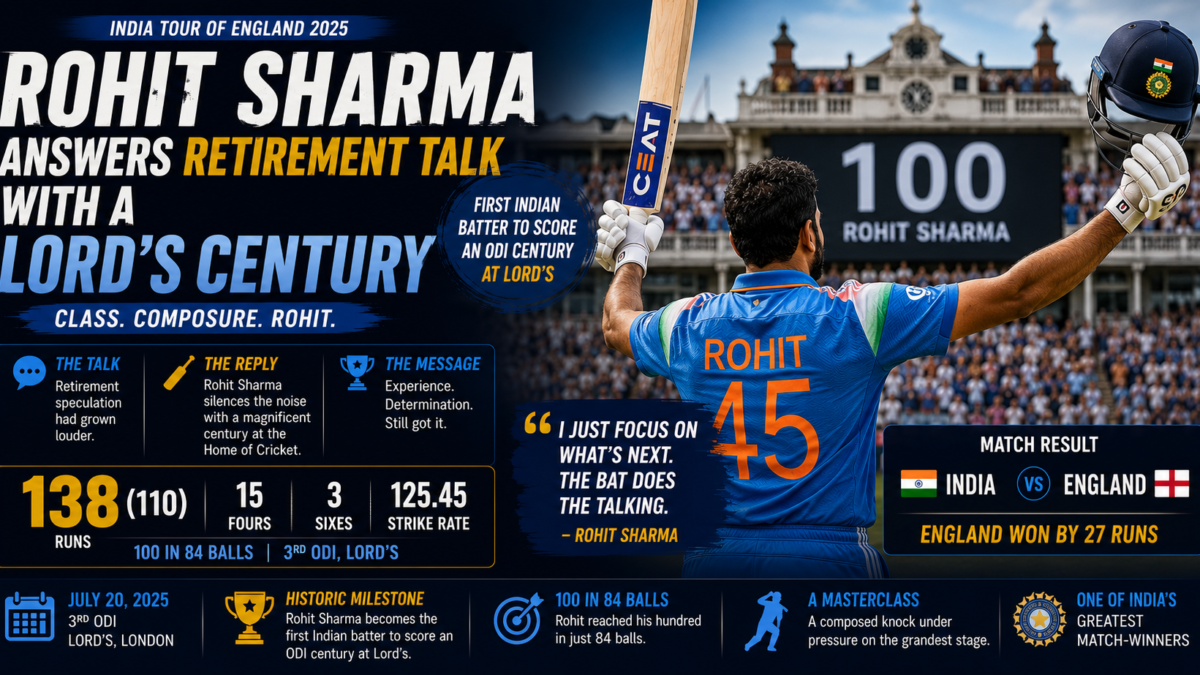
Rohit Sharma walked out at Lord’s on Sunday with the week’s entire news cycle strapped to his shoulders. Reports had suggested the selectors were moving on, that a transition towards younger players before the 2027 World Cup no longer included him, and that this might be the last time he opened the batting for India in a one-day international. He responded with 138 off 110 balls, the first ODI century by an Indian at Lord’s.
The Innings
It was not a nostalgic knock. Rohit batted with the tempo of a man chasing a total rather than a farewell, and India needed exactly that, because England had posted 387 for 3. Ben Duckett made 141, Jacob Bethell added 91 and Joe Root finished unbeaten on 74 in an innings that never gave India’s bowlers a foothold.
Rohit and captain Shubman Gill put on 147 for the first wicket before Gill was trapped lbw by Adil Rashid for 77. That partnership kept India genuinely in the chase, and for a stretch either side of the thirtieth over the required rate looked negotiable rather than fanciful.
The innings ended when Bethell bowled him as he attempted a sweep, and India’s pursuit ended not long after. They finished on 360 for 7, twenty-seven runs short, having scored more than any Indian side has managed in a losing ODI cause at the ground.
The Retirement Question
BCCI secretary Devajit Saikia had publicly dismissed the retirement speculation before the match, but the reporting persisted, including claims that Rohit’s family had travelled to London. In that atmosphere, a hundred functions as an argument rather than an innings.
The awkward reality is that both things can be true at once. A thirty-nine-year-old opener can play a century of genuine quality and still not be part of a selection plan aimed at a tournament eighteen months away. Selection committees make decisions about trajectories, not individual innings, and one of the more uncomfortable features of a long career is that the evidence of what a player can still do rarely settles the question of what a team should do.
What Rohit has done is make the decision harder to explain. Retiring a batter who has just become the first Indian to score an ODI century at Lord’s requires a clearer public rationale than the one currently on offer.
The Series
England took the series 2-1 having already won the T20I leg 4-0. India’s only victory in the white-ball portion of the tour came in the opening ODI at Edgbaston, where Axar Patel and Gill combined to good effect.
The batting has not been the problem. Scoring 360 in a run chase and losing is a bowling failure, and England’s total was built on a surface that offered India’s attack almost nothing. Duckett in particular has spent this series treating India’s new-ball bowlers as a solved problem.
A Contrast at the Same Ground
The Indian summer at Lord’s has produced two very different stories. Days before the men’s defeat, India's women completed a 270-run win over England in the first Test at the same venue, one of the most emphatic results in the history of the fixture and a considerably happier piece of Indian cricket history at the ground.
What Happens Next
Rohit has not announced anything. He was not obliged to, and the manner of his dismissal, sweeping at a young spinner while trying to accelerate a chase, was the act of someone playing to win rather than to be remembered.
If it turns out to be his final ODI innings, it is an unusually good one to leave on: a hundred at the home of cricket, in a losing cause, made in the full knowledge of what was being written about him. If it is not, India’s selectors have a conversation to have that is now noticeably more complicated than it was on Saturday.




Leave a Reply