
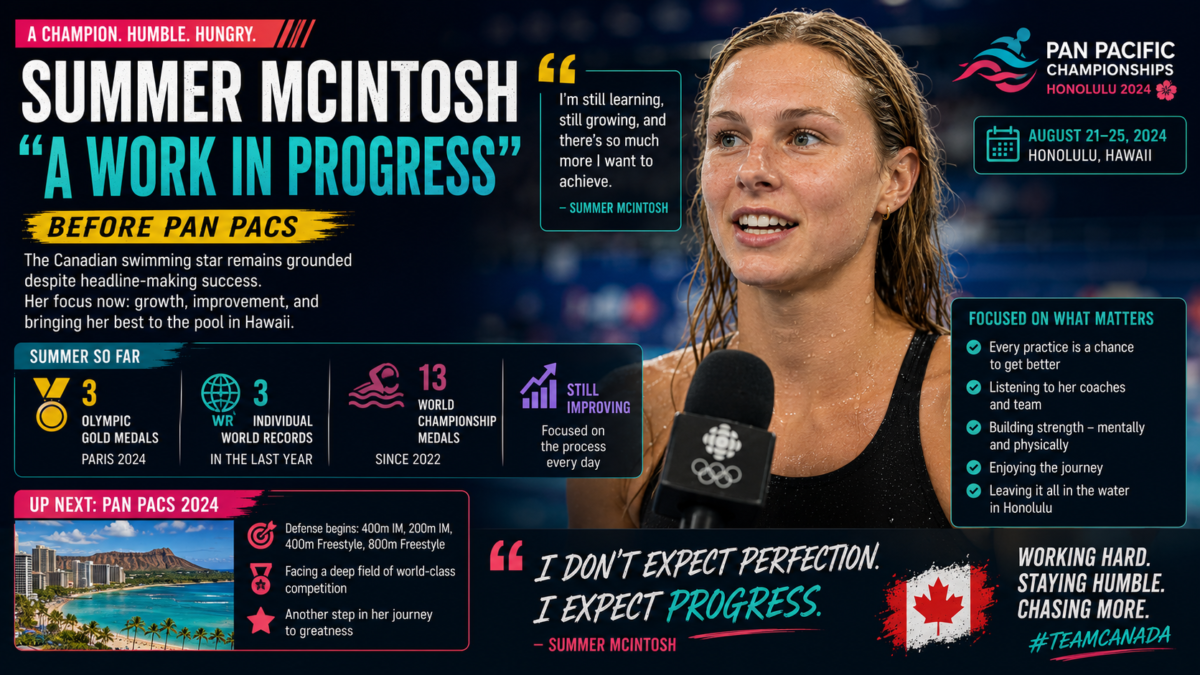
Summer McIntosh has spent the past two years rewriting record books, and her assessment of her own swimming is that it remains a work in progress. That is either false modesty or the most revealing thing she has said all season, and the evidence suggests the latter.
The Schedule
McIntosh heads to the Pan Pacific Swimming Championships at the William Woollett Jr. Aquatics Center in Irvine, California, running from 12 to 15 August. The meet returns after an eight-year absence, which gives it a novelty value that its position in the calendar might not otherwise justify.
She arrives having come through the Canadian trials in early July and as the headline name in a 44-strong Canadian squad that pairs Olympic and Paralympic veterans with a substantial group of first-time selections. Taylor Ruck leads alongside her, and the roster splits into twenty women and twenty-two men across the Pan Pacific and Para Pan Pacific programmes.
The programme McIntosh intends to contest is, as usual, ambitious to the point of being slightly absurd. She has built a career on refusing to specialise, swimming individual medley, butterfly and freestyle events at the same meet with a schedule that would exhaust most swimmers who contest a third of it.
Why the Mindset Matters
Athletes at McIntosh’s level face a specific trap. Once you hold world records, the sport’s default framing becomes defensive: can she hold the mark, can she repeat the performance, has she peaked. Framing your own swimming as unfinished is a way of refusing that conversation entirely.
It is also, in her case, accurate. She broke the oldest world record in women's swimming earlier this month in the 200m butterfly, a mark that had survived every generational shift the sport has thrown at it. Swimmers who take down records of that vintage generally do so at the outer edge of their capability. McIntosh did it in a season she is treating as preparation.
The Value of a Non-Championship Summer
Pan Pacs occupies an unusual place in the swimming calendar. It is not a world championship and it is not an Olympics, which means the pressure profile is different and the racing can be used as construction rather than as a verdict. For a swimmer with a schedule as broad as McIntosh’s, that is genuinely useful: it is a chance to test event combinations, recovery windows and heat-to-final management against high-quality fields without a career-defining result attached.
The competitive standard will still be serious. Pan Pacs draws the United States, Australia, Japan and Canada, which between them account for the overwhelming majority of the medals at any major long-course meet. Racing that group in August is closer to a dress rehearsal than an exhibition.
The LA Horizon
Everything in swimming currently points towards Los Angeles in 2028, and McIntosh will be twenty-one when those Games open. The gap between now and then is exactly long enough for a swimmer to reconstruct a stroke, add an event, or lose their way entirely.
Her stated approach, treating each season as an iteration rather than a peak, is the version most likely to survive that timeline intact. Swimmers who arrive at a home-continent Olympics having spent the intervening years defending records tend to arrive tired. Swimmers who arrive still adding things tend to arrive dangerous.
What to Watch in Irvine
The specific question in August is how many events she can contest at close to full capacity across four days. That number, more than any individual time, is the metric that determines what her Olympic programme can realistically look like.
If Irvine tells her she can hold a five or six-event schedule without the back half falling away, the planning for the next two years becomes considerably more aggressive. If it tells her otherwise, better to learn it at a Pan Pacific Championships in August 2026 than at an Olympic pool in the summer of 2028.

Leave a Reply