
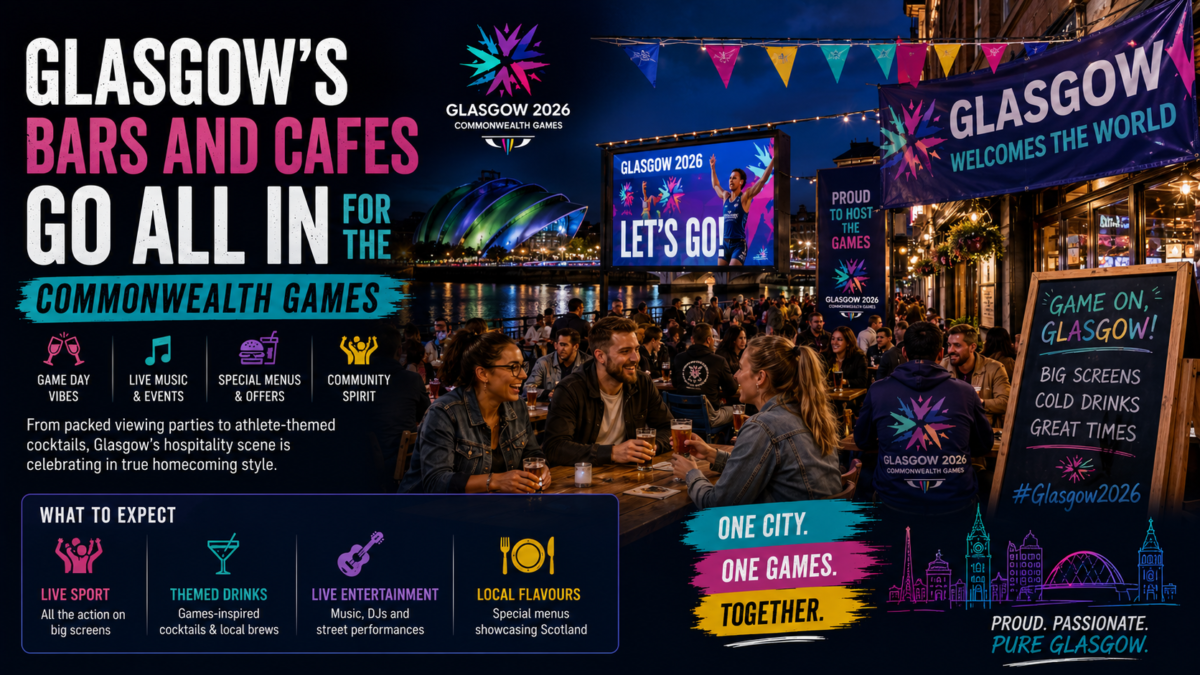
Host cities usually announce their readiness through infrastructure milestones and transport plans. Glasgow has chosen to announce its readiness through coffee foam. More than seventy cafes, bars, restaurants and hotels across the city have signed up to the All In Welcome, a citywide hospitality campaign running through the eleven days of Commonwealth Games competition.
How It Works
Participating venues will serve coffees, cocktails and signature drinks finished with the official All In mark. The mark is applied using reusable stencils made from repurposed ocean plastic, a detail that connects the campaign to the Commonwealth Clean Oceans Plastics initiative linked to the King’s Baton Relay.
Selected venues will also donate one pound from featured cocktails to the Commonwealth Sport Foundation, the official charity partner of Glasgow 2026, which funds programmes using sport to promote inclusion across Commonwealth nations.
The campaign sits within Glasgow 2026’s broader All In programme and is delivered by Glasgow Chamber of Commerce’s Circular Glasgow initiative, supported by Sustainable Glasgow and Glasgow City Council’s sustainability team. Participating venues are listed publicly so visitors can find them without hunting.
Why a Drinks Stencil Is Not a Trivial Story
It would be easy to file this under municipal window dressing. That would miss what the campaign is actually attempting. Glasgow took on these Games at short notice and with a substantially reduced budget after the original host withdrew, and the central argument for staging them at all was that a smaller, tighter, more city-centred event could still deliver the atmosphere that makes a multi-sport Games worth attending.
Atmosphere is the one thing organising committees cannot buy. Venues can be built and schedules can be published, but the sense that a city has collectively decided to show up is generated by thousands of small independent decisions made by people with no formal connection to the event. Seventy hospitality businesses agreeing to change how they serve drinks for eleven days is one of those decisions rendered visible.
The Sustainability Angle
The reusable-stencil detail is more than a gimmick. Glasgow 2026 has positioned itself as a proof of concept for a lower-cost, lower-footprint model of major event hosting, using existing venues rather than building new ones. A hospitality campaign built on repurposed materials rather than disposable branded merchandise is consistent with that argument, and it is the kind of consistency that gets noticed by cities weighing up whether to bid for anything in the future.
Whether the model works will be judged over the eleven days of competition rather than in advance. Around 3,000 athletes will compete across ten sports including athletics and para athletics, swimming and para swimming, artistic gymnastics, boxing, judo, netball, bowls, track cycling, weightlifting and para powerlifting, and 3×3 basketball, alongside the largest para sport medal programme in the history of the Games.
The Wider Countdown
The hospitality launch arrives in a week thick with final preparations. The opening ceremony lineup has continued to grow, with the King and Queen due to attend at the Hydro on 23 July, and home-nation squads have been finalised, including a Team Scotland athletics group led by familiar names.
The competition itself runs from 23 July to 2 August. By the time it closes, the question of whether a compact, borrowed-venue, hospitality-driven Games can generate the feeling of a proper multi-sport event will have an answer.
What Visitors Will Notice
For the spectator arriving in Glasgow with a ticket for the netball or the track cycling, the campaign will register as something simpler than a sustainability initiative or an economic development strategy. It will register as a city that has bothered.
That is the entire point. The venues signing up are not doing so because a stencilled logo will transform their trading figures over eleven days. They are doing so because Glasgow has staged this kind of event before, in 2014, and the institutional memory of what that felt like is still strong enough to mobilise a hospitality sector without much persuasion.

Leave a Reply