
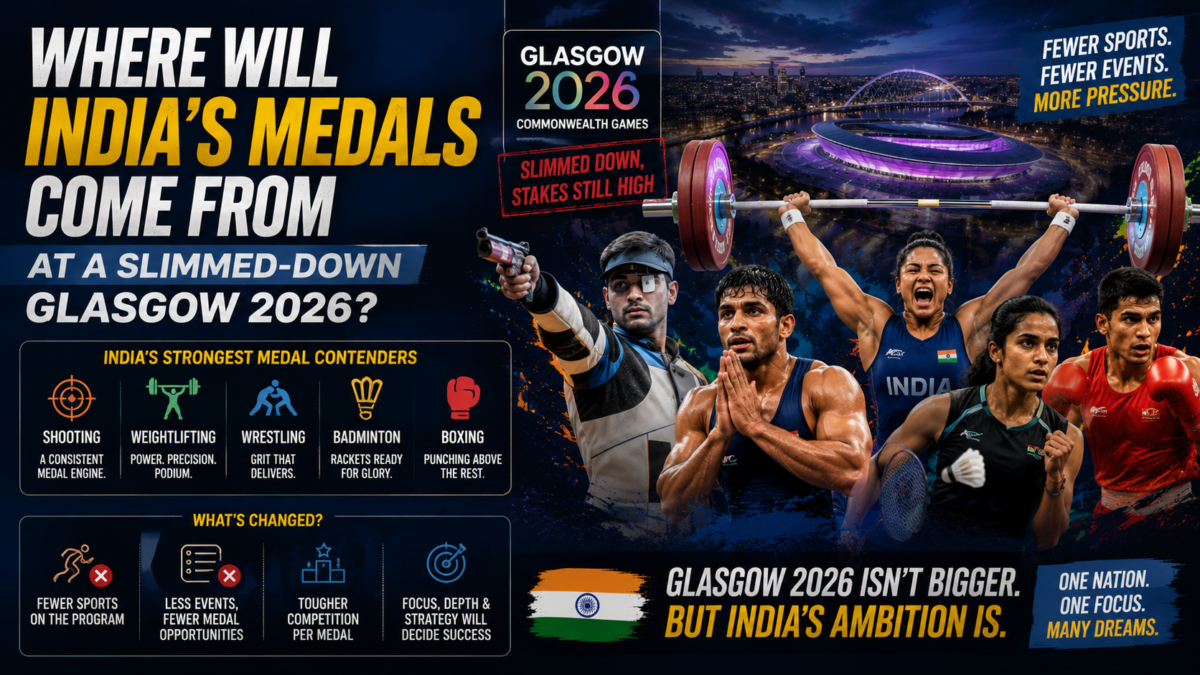
Two weeks from the opening ceremony, the defining question of India’s Commonwealth Games campaign is not who will win medals, but where they can be won at all. The stripped-back ten-sport programme for Glasgow 2026 has removed shooting, wrestling, badminton, hockey and cricket, disciplines that together supplied nearly half of India’s hauls at recent editions. For the 124-member contingent given its ceremonial send-off last week, the arithmetic has fundamentally changed.
The Banker Events
What remains still offers genuine podium depth. Weightlifting has been India’s most reliable source of Commonwealth gold outside the axed sports, and Mirabai Chanu headlines a lifting squad that traditionally converts a large share of its entries into medals. Boxing, with Lovlina Borgohain leading the challenge, is the other discipline where India arrives expecting rather than hoping, and the compressed programme means those two sports now carry a disproportionate share of the medal-target burden.
Athletics offers the marquee moment. Neeraj Chopra, who confirmed his form by meeting the Games qualifying mark on the Diamond League circuit this season, will start as the headline favourite in the javelin at Scotstoun Stadium, seeking the one major title cadence his career has established: win, defend, repeat. Around him, India’s middle-distance and steeplechase group has genuine finalist potential, though converting finals into medals against Kenyan and English depth remains the harder step.
The Swing Sports
The genuine uncertainty lies in the pool and on the judo mat. Swimming at Tollcross offers 42 able-bodied events but an unforgiving standard, with Australia, England and Canada hoovering up most finals; an Indian medal there would rank among the campaign’s biggest stories. Judo, bowls and para sport, by contrast, have quietly become dependable contributors, and the team’s planners believe the lawn bowls squad in particular can repeat its Birmingham heroics. Track cycling and artistic gymnastics complete the programme, both areas where India fields competitors rather than contenders.
The honest projection is a total well below the 61 medals of Birmingham 2022, through no fault of the athletes. When half a nation’s strongest events are removed from the schedule, the measure of success has to shift from volume to conversion: how many of the realistic chances become podiums.
A Different Kind of Test
There is a larger stake here than one medal table. With Glasgow's reinvented, compact Games positioning itself as a template for the Commonwealth movement’s survival, India’s performance in a programme built around traditional British strengths will feed directly into its argument for hosting and shaping future editions. A strong showing in the sports that remain would demonstrate that Indian sport’s rise no longer depends on a favourable event list. That, more than any single gold, is the result worth watching for.


Leave a Reply