
An Ally Breaks Ranks
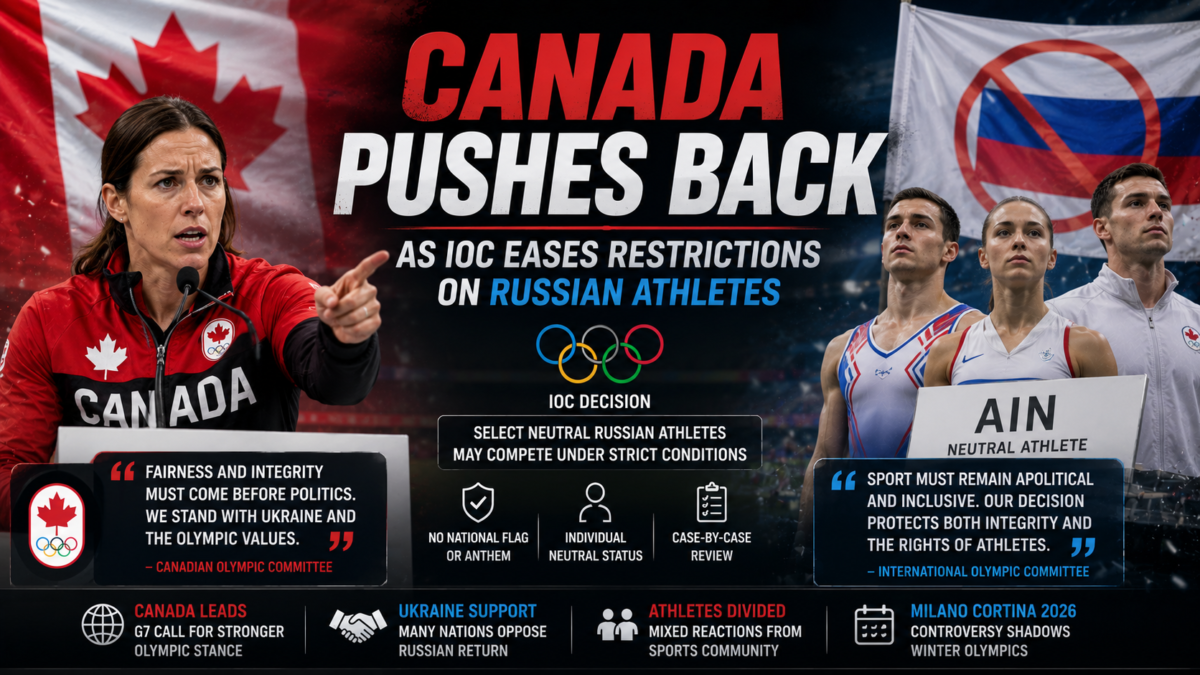
The International Olympic Committee’s decision to ease its suspension of Russia has met its first major government pushback. Canada’s Secretary of State for Sport, Adam van Koeverden, says he is appalled by the move and has confirmed that Canada will not allow Russian athletes to take part in any domestic sports events funded by Ottawa — the strongest objection yet from a major Olympic nation.
Van Koeverden, himself a four-time Olympic medallist in kayaking, did not soften his language. The countries of Russia and Belarus, he wrote, should not be represented in international sports competitions while Russia’s illegal and unjustifiable full-scale invasion of Ukraine continues. Coming from a sitting minister who once wore the maple leaf on Olympic podiums, the statement carries weight both political and sporting.
What the IOC Actually Changed
The objection follows the IOC's provisional lifting of the Russian Olympic Committee's suspension earlier this week, a decision that opens the door for Russian athletes to compete at the LA 2028 Games. Since October 2023, Russian and Belarusian athletes had been permitted to compete only as vetted “individual neutral athletes,” screened for ties to the military and security agencies and stripped of flag and anthem. Under the new arrangement, that vetting requirement is no longer in place.
The IOC has said it will decide at a later date whether Russians could compete in Los Angeles under their own flag and anthem — the most symbolically charged question of all. But for critics, removing the vetting layer already goes too far, effectively normalising Russia’s return while the war that prompted the suspension continues.
A Rift With No Easy Resolution
Canada’s stance sets up an awkward standoff within the Olympic movement. As a recent Winter Olympics host and one of the largest funders of amateur sport among Western nations, Canada’s refusal to admit Russian athletes to federally funded events could complicate qualification competitions, world cups and championships held on Canadian soil in the run-up to 2028 — events that international federations rely on hosting partners to deliver.
Ukraine’s government and several European sports ministries have voiced similar concerns in the past, and the question now is whether Canada’s hard line becomes a rallying point or an outlier. The IOC, for its part, is betting that time and the pull of universal participation will bring member nations along, as it largely did before Paris 2024.
What is certain is that the road to Los Angeles now carries a live diplomatic dispute. The IOC wanted its Russia decision to close a difficult chapter; Canada’s response suggests the chapter is far from finished, and the two years before LA 2028 will test how much dissent the Olympic family can absorb.



Leave a Reply