
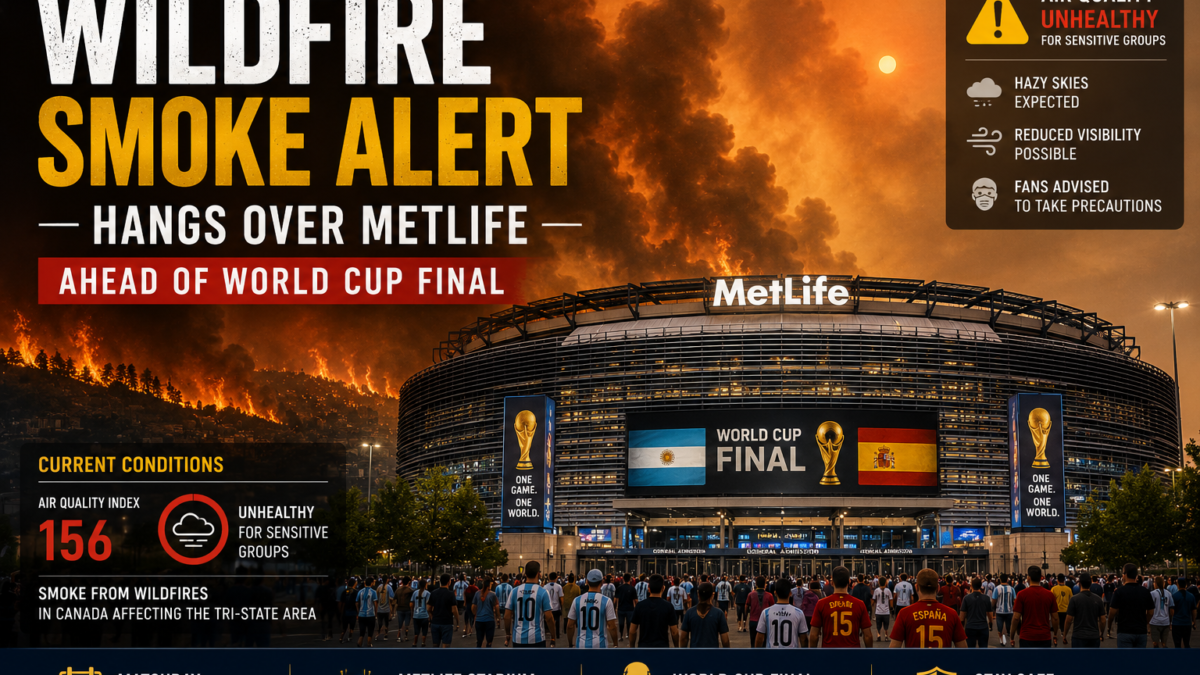
The last significant obstacle standing between the 2026 World Cup and a clean finish is not a defensive line or a goalkeeper. It is the air. Officials in New York and New Jersey issued air quality health alerts this week as smoke from Canadian wildfires drifted south across the Northeast, arriving days before the final between Spain and Argentina at the open-air stadium in East Rutherford.
Why an Open-Air Final Complicates Things
MetLife Stadium has no roof. That was never a problem when the venue was selected, but it becomes one when a haze of fine particulate matter settles over the metropolitan area. More than eighty thousand supporters are expected inside for the final, and the realistic figure for people on site across the full matchday, counting staff, media, security and the pre-match build-up, pushes close to a hundred thousand. Many of them will spend five hours or more outdoors.
Health advice during an air quality alert is straightforward and awkwardly incompatible with a World Cup final: stay indoors where possible and avoid strenuous outdoor activity. For supporters that mostly means discomfort. For the twenty-two players on the pitch, a match that could stretch to extra time and penalties, it is a genuine performance variable, particularly for anyone with a respiratory condition.
The Forecast Is Moving in the Right Direction
The more encouraging news is that conditions look likely to improve. Forecasters tracked the smoke lingering over parts of the Northeast through the end of the week, but a storm system moving through the region on Saturday is expected to scour much of it out of the atmosphere before Sunday afternoon. Temperatures at kickoff are projected to sit in the low eighties Fahrenheit, warm but manageable for a mid-summer final.
The caveat is that the forecast remains fluid. Smoke plumes are notoriously hard to model more than a day or two ahead, and a shift in wind direction can undo an otherwise favourable outlook within hours. Skies may still carry some haze even if the underlying air quality readings recover. Authorities have described themselves as monitoring the situation rather than contemplating any change to the schedule, and there has been no suggestion from FIFA that the fixture is at risk.
How the Teams Have Responded
Spain trained outdoors on Thursday and showed no visible sign of adjusting their preparation. The squad has not publicly addressed whether the air quality is a concern, which is itself a fairly typical piece of tournament management in the days before a final, when every stray comment becomes a headline. Argentina, arriving in New Jersey from Atlanta after their semifinal win over England, have been similarly quiet on the subject.
There is a competitive logic to the silence. Neither camp wants to hand the other a pre-built excuse, and neither wants to plant the idea in their own players’ heads that the conditions might be a factor. Elite squads generally prefer to treat weather as something to absorb rather than negotiate.
A Reminder of a Broader Problem
The episode is a small illustration of a much larger question facing major outdoor sport. Wildfire smoke events in North America have become more frequent and more severe over the past decade, and summer tournaments scheduled in June and July increasingly run into them. This World Cup has already navigated extreme heat in several host cities, with matches played in conditions that prompted extended cooling breaks and, in some venues, revised kickoff times.
Organisers of the Los Angeles 2028 Olympic Games and future World Cups will be studying how this summer was handled, because the planning assumptions that governed venue selection twenty years ago no longer hold reliably. Air quality monitoring is becoming as routine a part of matchday operations as pitch inspections.
The Match Still Comes First
For now, the expectation is that Sunday goes ahead as planned, under skies that may be hazy but breathable, with a storm having done the cleaning work overnight. Supporters travelling to East Rutherford have been advised to check local air quality readings on the day and to take sensible precautions, particularly those with asthma or other respiratory conditions.
Everything else about the final is set. Spain against Argentina, the European champions against the world champions, with the trophy and a place in the sport’s permanent record on the line. The weather will do what it does. The football, mercifully, looks unlikely to be affected.




Leave a Reply