
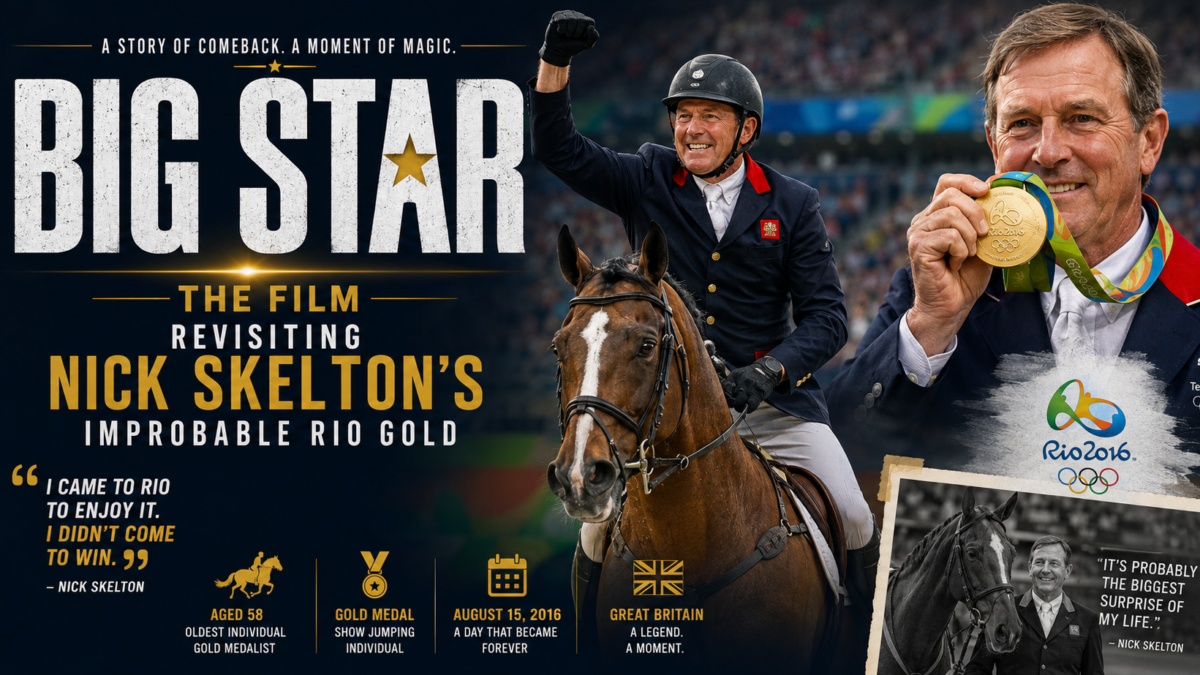
Ten years on, the Nick Skelton story still sounds like something a scriptwriter would be told to tone down. A 58-year-old show jumper with a broken neck in his medical history and an artificial hip walks into the Rio 2016 Olympic arena and wins individual gold, becoming the oldest British athlete to win an individual Olympic title in more than a century. A documentary now playing in cinemas and heading to streaming has gone back to work out how it happened.
The fall that should have ended it
Big Star: The Nick Skelton Story, directed and produced by Sarah George, takes its title from the horse rather than the rider, which is the correct decision and tells you a good deal about how the film approaches its subject. It begins with the accident. In 2000 Skelton broke his neck in a fall at Parkgate, an injury doctors told him should end his career permanently. He retired. Two years later he was back on a horse and out of retirement, a decision that most people around him regarded as somewhere between reckless and incomprehensible.
What followed was a second career longer and more successful than the first. Team gold at London 2012 with Big Star as his partner, then the individual title in Rio four years later, by which point the horse had suffered his own career-threatening injury and both of them were widely assumed to be finished. They retired together in 2017.
The horse as co-lead
The film’s real achievement, according to reviewers who have praised it heavily since its cinema release, is that it treats Big Star as a character rather than equipment. That is harder than it sounds. Equestrian sport is the only Olympic discipline in which an animal is a medallist in everything but name, and most sports documentaries struggle to convey the relationship without either sentimentalising it or ignoring it.
The partnership between horse and rider is what makes equestrian storytelling distinctive, and it also makes it fragile. Careers end when a horse's does, and the emotional weight of that has been documented elsewhere in the sport. Skelton and Big Star were unusual in that both came back from injuries that should have finished them, at the same time, and then peaked together on the biggest stage available.
Rio, ten years on
The timing of the film’s release is not accidental. Rio 2016 is passing its decade mark, and the anniversary has produced a steady stream of retrospectives on a Games that produced more than its share of unrepeatable moments, from the three-way tie for silver in the 100m butterfly to breakthrough golds that changed lives in countries with thin Olympic histories.
Skelton’s belongs firmly in that category, though it sits slightly apart because of the age. Olympic gold medallists in their late fifties are vanishingly rare in any sport, and equestrian is essentially the only discipline where it remains possible. That fact is a defence of the sport’s place on the programme in its own right, though it is also the thing that makes his win difficult for outsiders to evaluate. Was it a triumph of experience, of horsemanship, or of simply refusing to leave?
What the film is actually about
The answer the documentary lands on is stubbornness, and it is honest enough not to dress that up as inspiration. Skelton comes across as a man who was not especially interested in what was sensible, who found the sport more compelling than the risks it carried, and who happened to be paired with a horse of comparable temperament.
It is showing in cinemas now with streaming platforms to follow, and it has drawn strong reviews from equestrian and general critics alike. For a sport that rarely gets feature-length treatment outside its own media, that is worth something. For anyone who watched Rio and wondered how a man that age was still doing that, it is the explanation.

Leave a Reply