
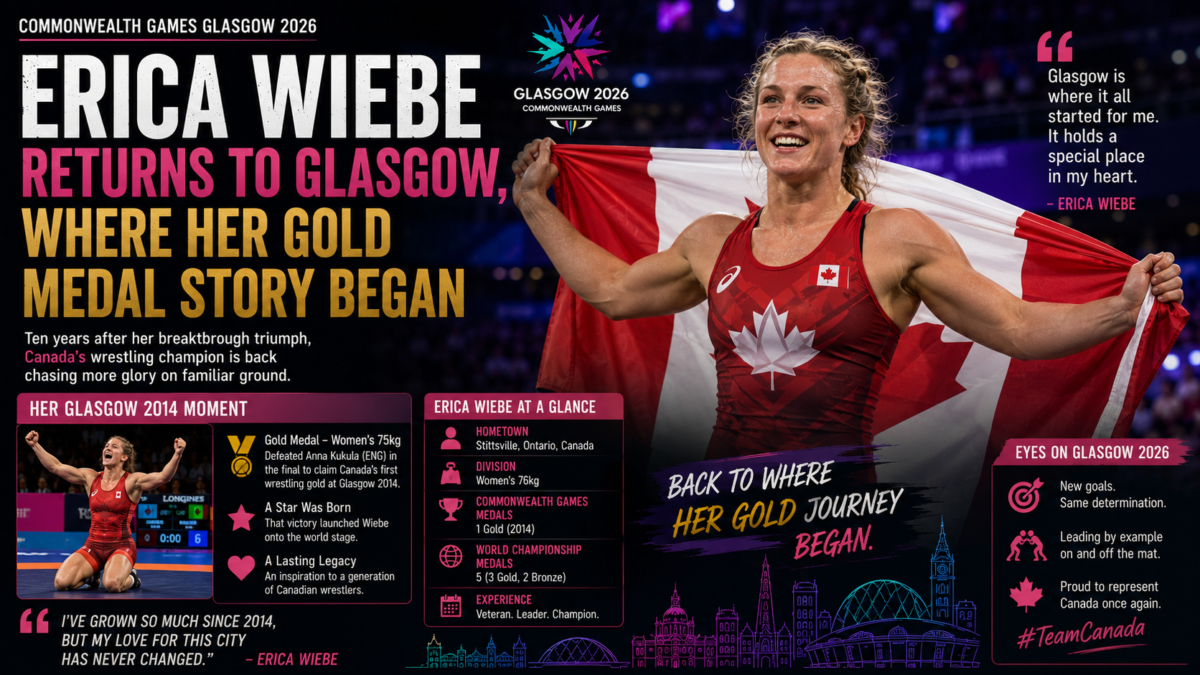
Twelve years ago a 25-year-old wrestler from Stittsville, Ontario walked into a Glasgow venue as a relative unknown and walked out a Commonwealth champion. This week Erica Wiebe walks back into the same city, only this time she is wearing a blazer instead of a singlet, and 149 Canadian athletes are following her lead.
From the mat to the front of the room
Wiebe’s appointment as Team Canada’s Chef de Mission for the Glasgow 2026 Commonwealth Games is one of those rare sporting appointments that reads like a scriptwriter’s idea. Glasgow 2014 was her breakthrough, the first major international title of a career that would eventually include a second Commonwealth crown on the Gold Coast in 2018 and, most famously, Olympic gold in freestyle wrestling at Rio 2016. That Rio final remains one of the defining Canadian moments of those Games, a performance built on relentless pressure rather than flourish.
The role she takes on now is a very different kind of work. A Chef de Mission is part logistics chief, part diplomat and part den mother, the person athletes turn to when accreditation goes missing, when a competition schedule shifts, or when the weight of an occasion becomes heavier than expected. Wiebe has spent recent years working in athlete relations, safe sport and equity roles at the Canadian Olympic Committee, and she arrives in Glasgow with an MBA and a broadcasting career behind her as well. It is a resume assembled almost deliberately for this job.
Why the symbolism matters
There is a practical reason her presence carries weight. Wrestling is not on the Glasgow 2026 programme, one of several sports cut when the Games were reshaped into a leaner ten-sport event after Victoria withdrew as host. For a wrestler to lead the Canadian delegation into a Games where her own sport is absent is a pointed reminder of what the Commonwealth movement gains and loses each time it reinvents itself. Wiebe has spoken openly about how the Commonwealth Games gave her a first taste of a major multi-sport environment, the kind of exposure that made Rio survivable two years later.
Canada’s 149-athlete team includes a mix of Olympic medallists and first-time internationals, and it is the younger group that Wiebe seems most focused on. The Commonwealth Games have always functioned as a stepping stone rather than a summit, a place where an athlete learns how to sleep in a village, eat in a dining hall the size of an aircraft hangar, and compete in front of a crowd that is not their own. With Los Angeles 2028 now two years away, that education has a clear deadline attached to it.
A Games that needs its storytellers
Glasgow 2026 is a deliberately modest event by recent standards, staged across a compact cluster of venues with a reduced sport programme and a fraction of the budget that Birmingham 2022 commanded. Organisers have leaned into the idea that intimacy is a feature rather than a compromise, and the city has responded warmly, with bars, cafes and cultural venues across Glasgow throwing themselves into the welcome. Athletes have been arriving in a steady stream at Glasgow International Airport all week, greeted by volunteers in the Games’ purple uniforms.
In that context, having a figurehead who genuinely remembers what 2014 felt like is worth more than any marketing campaign. Wiebe was there when Glasgow last did this, when the Hydro and Scotstoun filled up and the city discovered it rather enjoyed being a host. She can tell athletes what to expect not from a briefing document but from memory.
The full circle
The Games open on Thursday at the Hydro, with the King and Queen in attendance and the King’s Baton Relay reaching its conclusion. Canada’s flag will pass through the arena carried by an athlete Wiebe will have helped choose, in a building a short distance from where she once stood on top of a Commonwealth podium.
Careers in sport rarely resolve this neatly. Most athletes drift away from their sport, resurfacing occasionally at reunions and anniversary features. Wiebe has instead found a way to stay useful, converting a competitor’s understanding of pressure into something she can hand to the next group. Whether Canada leaves Glasgow with a big medal haul or a modest one, the more interesting measure will be how many of those 149 athletes come away feeling that somebody in the building understood exactly what they were going through. On that count, Team Canada has picked well.



Leave a Reply