
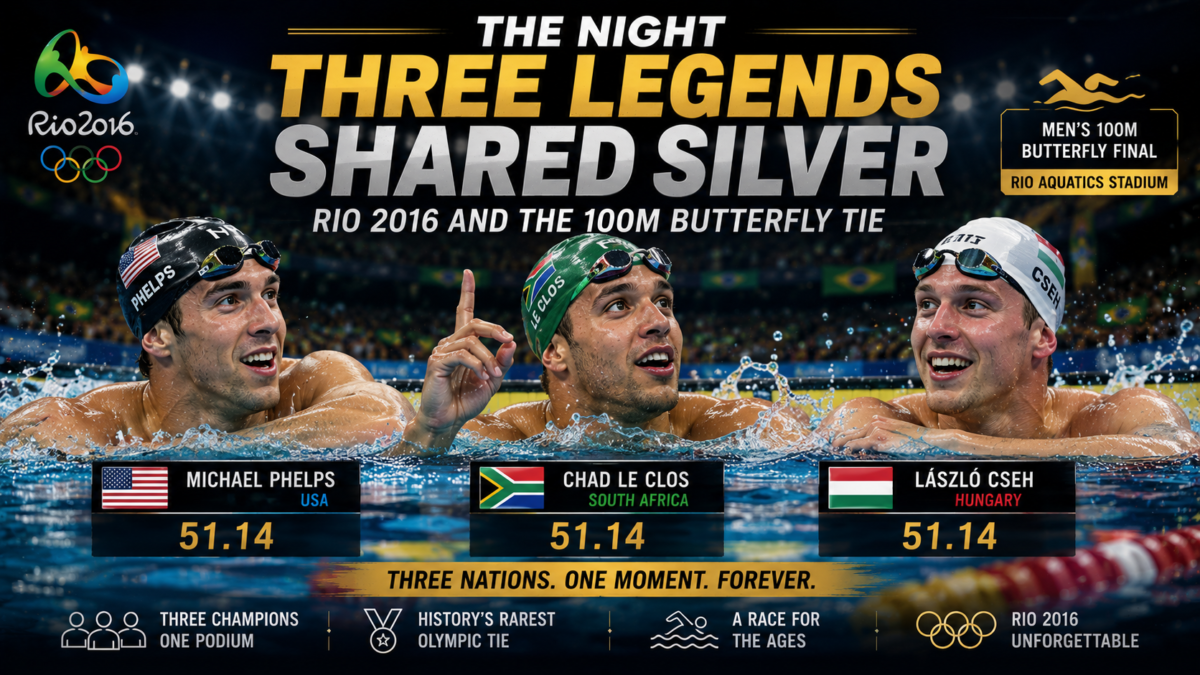
Ten years on, it remains the most improbable scoreboard in Olympic swimming history. Rio de Janeiro, August 2016, the final of the men’s 100 metres butterfly: one gold medal, no bronze awarded, and three of the greatest swimmers of their generation locked together on the silver step. This week’s wave of Rio anniversary nostalgia has put the race back in circulation, and it has lost none of its strangeness.
Fifty Metres That Broke the Scoreboard
The story of the race is usually told through the winner, and rightly so. Joseph Schooling, a 21-year-old from Singapore who had queued for a photograph with Michael Phelps as a schoolboy in 2008, beat his idol to the wall in 50.39 seconds, an Olympic record and his country’s first Olympic gold in any sport. But the touch behind him produced something the sport had never seen at that level. Phelps, Chad le Clos of South Africa and Hungary’s Laszlo Cseh, three men with a combined two dozen Olympic medals, stopped the clock at exactly 51.14. Not close. Identical, to the hundredth of a second that Olympic timing permits.
The tie meant three silver medals, no bronze, and a medal ceremony unlike any other, four men on two steps, with Phelps, le Clos and Cseh linking arms in a shared shrug at the mathematics of it. Timing officials later confirmed what the sport already knew: the technology can measure finer margins, but the rules deliberately stop at hundredths because pool construction tolerances make anything finer unfair. The dead heat was not a measurement failure. It was the sport’s honesty about its own limits.
What the Moment Meant
Each man brought a different story to that wall. For Phelps, it was the final individual Olympic race of the greatest career in the sport’s history, a silver that somehow burnished the legend rather than diminishing it. For le Clos, who had beaten Phelps for gold in London four years earlier and feuded with him through the buildup, it was an armistice written in race results. For Cseh, the eternal contender who spent a career finishing behind Phelps, sharing a podium step with him at last carried its own quiet poetry.
The race has aged into a parable about the sport itself, one that this site keeps returning to in stories like the breaststroke lineage running from Adam Peaty to Filip Nowacki: swimming’s eras do not replace each other so much as touch the same wall together. Schooling’s win proved champions can come from anywhere. The triple silver behind him proved that greatness, measured honestly, sometimes refuses to be ranked. A decade later, no Olympic final has repeated the trick, and it is possible none ever will.

Leave a Reply